Introduction
GRI 12: Coal Sector 2022 provides information for organizations in the coal sector about their likely material topics. These topics are likely to be material for organizations in the coal sector on the basis of the sector’s most significant impacts on the economy, environment, and people, including on their human rights.
GRI 12 also contains a list of disclosures for organizations in the coal sector to report in relation to each likely material topic. This includes disclosures from the GRI Topic Standards and other sources.
The Standard is structured as follows:
- Section 1 provides a high-level overview of the coal sector, including its activities, business relationships, context, and the connections between the United Nations Sustainable Development Goals (SDGs) and the likely material topics for the sector.
- Section 2 outlines the topics that are likely to be material for organizations in the coal sector and therefore potentially merit reporting. For each likely material topic, the sector’s most significant impacts are described and disclosures to report information about the organization’s impacts in relation to the topic are listed.
- The Glossary contains defined terms with a specific meaning when used in the GRI Standards. The terms are underlined in the text and linked to the definitions.
- The Bibliography contains authoritative intergovernmental instruments and additional references used in developing this Standard, listed by topic. It also lists further resources that the organization can consult.
The rest of the Introduction section provides an overview of the sector this Standard applies to, an overview of the system of GRI Standards, and further information on using this Standard.
Sector this Standard applies to
GRI 12 applies to organizations undertaking any of the following:
- Exploration, mining, and processing of thermal and metallurgical coal (i.e., lignite, subbituminous coal, bituminous coal, and anthracite) from underground or open-pit mines.
- Supply of equipment and services to coal mines, such as drilling, exploration, seismic information services, and mine construction.
- Transportation and storage of coal, such as slurry pipelines.
This Standard can be used by any organization in the coal sector, regardless of size, type, geographic location, or reporting experience.
The organization must use all applicable Sector Standards for the sectors in which it has substantial activities.
Sector classifications
Table 1 lists industry groupings relevant to the coal sector covered in this Standard in the Global Industry Classification Standard (GICS®) [4], the Industry Classification Benchmark (ICB) [3], the International Standard Industrial Classification of All Economic Activities (ISIC) [6], and the Sustainable Industry Classification System (SICS®) [5]1. The table is intended to assist an organization in identifying whether GRI 12 applies to it and is for reference only.
Table 1. Industry groupings relevant to the coal sector in other classification systems
| CLASSIFICATION SYSTEM | CLASSIFICATION NUMBER | CLASSIFICATION NAME |
| GICS® | 10102050 | Coal & Consumable Fuels |
| ICB | 60101040 | Coal |
| ISIC | B05 | Mining of coal and lignite |
| SICS® | EM-CO | Coal Operations |
System of GRI Standards
This Standard is part of the GRI Sustainability Reporting Standards (GRI Standards). The GRI Standards enable an organization to report information about its most significant impacts on the economy, environment, and people, including impacts on their human rights, and how it manages these impacts.
The GRI Standards are structured as a system of interrelated standards that are organized into three series: GRI Universal Standards, GRI Sector Standards, and GRI Topic Standards (see Figure 1 in this Standard).
Universal Standards: GRI 1, GRI 2 and GRI 3
GRI 1: Foundation 2021 specifies the requirements that the organization must comply with to report in accordance with the GRI Standards. The organization begins using the GRI Standards by consulting GRI 1.
GRI 2: General Disclosures 2021 contains disclosures that the organization uses to provide information about its reporting practices and other organizational details, such as its activities, governance, and policies.
GRI 3: Material Topics 2021 provides guidance on how to determine material topics. It also contains disclosures that the organization uses to report information about its process of determining material topics, its list of material topics, and how it manages each topic.
Sector Standards
The Sector Standards provide information for organizations about their likely material topics. The organization uses the Sector Standards that apply to its sectors when determining its material topics and when determining what to report for each material topic.
Topic Standards
The Topic Standards contain disclosures that the organization uses to report information about its impacts in relation to particular topics. The organization uses the Topic Standards according to the list of material topics it has determined using GRI 3.
Using this Standard
An organization in the coal sector reporting in accordance with the GRI Standards is required to use this Standard when determining its material topics and then when determining what information to report for the material topics.
Determining material topics
Material topics represent an organization’s most significant impacts on the economy, environment, and people, including their human rights.
Section 1 of this Standard provides contextual information that can help the organization in identifying and assessing its impacts.
Section 2 outlines the topics that are likely to be material for organizations in the coal sector. The organization is required to review each topic described and determine whether it is a material topic for it.
The organization needs to use this Standard when determining its material topics. However, circumstances for each organization vary, and the organization needs to determine its material topics according to its specific circumstances, such as its business model; geographic, cultural, and legal operating context; ownership structure; and the nature of its impacts. Because of this, not all topics listed in this Standard may be material for all organizations in the coal sector. See GRI 3: Material Topics 2021 for step-by-step guidance on how to determine material topics.
If the organization has determined any of the topics included in this Standard as not material, then the organization is required to list them in the GRI content index and explain why they are not material.
See Requirement 3 in GRI 1: Foundation 2021 and Box 5 in GRI 3 for more information on using Sector Standards to determine material topics.
Determining what to report
For each material topic, an organization reports information about its impacts and how it manages these impacts.
Once an organization has determined a topic included in this Standard to be material, the Standard also helps the organization identify disclosures to report information about its impacts relating to that topic.
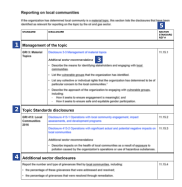
For each topic in section 2 of this Standard, a reporting sub-section is included. These sub-sections list disclosures from the GRI Topic Standards that are relevant to the topic. They may also list additional sector disclosures and recommendations for the organization to report. This is done in cases where the Topic Standards do not provide disclosures, or where the disclosures from the Topic Standards do not provide sufficient information about the organization’s impacts in relation to a topic. These additional sector disclosures and recommendations may be based on other sources. Figure 2 illustrates how the reporting included in each topic is structured.
The organization is required to report the disclosures from the Topic Standards listed for those topics it has determined to be material. If any of the Topic Standards disclosures listed are not relevant to the organization’s impacts, the organization is not required to report them. However, the organization is required to list these disclosures in the GRI content index and provide ‘not applicable’ as the reason for omission for not reporting the disclosures. See Requirement 6 in GRI 1: Foundation 2021 for more information on reasons for omission.
The additional sector disclosures and recommendations outline further information which has been identified as relevant for organizations in the coal sector to report in relation to a topic. The organization should provide sufficient information about its impacts in relation to each material topic, so that information users can make informed assessments and decisions about the organization. For this reason, reporting these additional sector disclosures and recommendations is encouraged, however it is not a requirement.
When the organization reports additional sector disclosures, it is required to list them in the GRI content index (see Requirement 7 in GRI 1).
If the organization reports information that applies to more than one material topic, it does not need to repeat it for each topic. The organization can report this information once, with a clear explanation of all the topics it covers.
If the organization intends to publish a standalone sustainability report, it does not need to repeat information that it has already reported publicly elsewhere, such as on web pages or in its annual report. In such a case, the organization can report on a required disclosure by providing a reference in the GRI content index as to where this information can be found (e.g., by providing a link to the web page or citing the page in the annual report where the information has been published).
See Requirement 5 in GRI 1 for more information on using Sector Standards to report disclosures.
GRI Sector Standard reference numbers
GRI Sector Standard reference numbers are included for all disclosures listed in this Standard, both those from GRI Standards and additional sector disclosures. When listing the disclosures from this Standard in the GRI content index, the organization is required to include the associated GRI Sector Standard reference numbers (see Requirement 7 in GRI 1: Foundation 2021). This identifier helps information users assess which of the disclosures listed in the applicable Sector Standards are included in the organization’s reporting.
Defined terms
Defined terms are underlined in the text of the GRI Standards and linked to their definitions in the Glossary. The organization is required to apply the definitions in the Glossary.
References and resources
The authoritative intergovernmental instruments and additional references used in developing this Standard, as well as further resources that may help report on likely material topics and can be consulted by the organization are listed in the Bibliography. These complement the references and resources listed in GRI 3: Material Topics 2021 and in the GRI Topic Standards.
Figure 2. Structure of reporting included in each topic
|
|
Management of the topic Topic Standards disclosures Additional sector recommendations Additional sector disclosures Sector Standard reference numbers |
1. Sector profile
Coal is a natural resource with its use dating back to ancient history. Coal extraction now represents a sizeable global sector supplying raw materials for energy generation and metallurgical processes. Thermal coal currently provides over a third of the global electricity output [22], while metallurgical coal is used primarily for steelmaking, accounting for 15% of world coal production [18]. Coal is also used to produce synthetic compounds, such as cement, dye, oil, waxes, pharmaceuticals, and pesticides.
Coal organizations are diverse in nature. While some focus on this sole commodity – combining extraction, distribution, and consumption channels under single ownership – others are large, diversified organizations, extracting different commodities or operating across different sectors. Some of the largest organizations in the sector are state-owned enterprises.
The burning of coal generates significant amounts of greenhouse gas (GHG) and other air emissions and is globally the largest single source of carbon dioxide (CO2) emissions [20]. The consumption of coal for electricity generation has widely been in decline [17] due to decarbonization efforts and the falling cost of renewables, shifting the focus towards less GHG intensive energy sources.
Sector activities and business relationships
Through their activities and business relationships, organizations can have an effect on the economy, environment, and people, and in turn make negative or positive contributions to sustainable development. When determining its material topics, the organization should consider the impacts of both its activities and its business relationships.
Activities
The impacts of an organization vary according to the types of activities it undertakes. The following list outlines some of the key activities of the coal sector, as defined in this Standard. This list is not exhaustive.
Prospecting and exploration: Surveying of resources, including feasibility assessments, geologic mapping, aerial photography, geophysical measuring, and drilling.
Development: Design, planning, and construction of mines, including processing and worker facilities.
Mining: Extraction of coal using surface mining, underground mining, or in situ techniques.
Processing: Crushing, cleaning, and processing coal from unwanted materials; processing it into briquettes, liquids, and gas or coke for steelmaking.
Closure and rehabilitation: Decommissioning processing facilities, land reclamation and rehabilitation, and closing and sealing waste facilities.
Transportation: Moving coal to the point of consumption by barge, conveyor belt, train, truck, or ship; or when mixed with oil or water, transported as coal slurry by pipeline.
Storage: Storage of coal at mining sites or import and export terminals.
Sales and marketing: Selling of coal products for the purpose of, for example, iron and steel production, cement production, electricity production, and manufacturing.
Business relationships
An organization’s business relationships include relationships that it has with business partners, with entities in its value chain including those beyond the first tier, and with any other entities directly linked to the organization’s operations, products, or services. The following types of business relationships are prevalent in the coal sector and are relevant when identifying the impacts of organizations in the sector.
Joint ventures are common arrangements in coal mining, in which organizations share the costs, benefits, and liabilities of assets or a project. An organization in the coal sector can be involved with negative impacts as a result of a joint venture, even if it is a non-operating partner.
Suppliers and contractors are often used in the coal sector during certain project phases, such as construction, or to provide other services or products. Some of the significant impacts covered in this Standard concern the supply chain.
Customers purchase coal and use it to produce energy, heat, and materials. When combusting coal, they generate greenhouse gases (GHG) and other air emissions. While the primary responsibility for reducing and managing their emissions lies with customers, organizations extracting coal are also expected to take actions to reduce emissions from the combustion of their products and to disclose the related GHG emissions (Scope 3 GHG emissions). As such, this Standard includes not only direct (Scope 1) and indirect (Scope 2) GHG emissions, but also other indirect (Scope 3) GHG emissions.
The sector and sustainable development
Coal has been a fundamental source of the world’s energy, contributing to economic growth and poverty reduction. However, coal is a major source of emissions that cause air pollution and anthropogenic climate change, which is affecting every region across the globe and causing negative impacts on the health, lives, livelihoods, and human rights of millions of people [36].
The majority of the world’s countries have committed to combating climate change by limiting the increase in global average temperatures to well below 2°C and pursue efforts to keep the increase at 1.5°C above pre-industrial levels, as outlined in the Paris Agreement [10]. However, based on the current ambitions to reduce GHG emissions communicated in the Nationally Determined Contributions (NDCs), the average temperature rise is projected to reach 2.7°C by 2100 [9]. This would lead to extreme climate and weather events occurring with increased frequency and intensity, and other long-term, irreversible impacts such as rising sea levels, melting of ice sheets, and warming and acidification of oceans.
The Intergovernmental Panel on Climate Change (IPCC) affirms global warming should be limited to 1.5°C [16], requiring a 45% reduction in CO2 emissions by 2030 as compared to 2010 levels, and reaching net-zero by 2050. Consequently, the world needs to transition to a low-carbon economy based on affordable, reliable, and sustainable energy. This transition would simultaneously address the issue of global air pollution. To achieve net-zero GHG emissions by 2050, the International Energy Agency (IEA) emphasizes the need to refrain from investments in new coal production or extensions of current mines [19]. The number of financial institutions divesting from thermal coal is steadily increasing, as climate policies, such as carbon pricing and air pollution regulations, and restrictions on public financing and subsidies, undermine the competitiveness of coal as a low-cost fuel [20].
The transition poses extraordinary challenges for organizations in the coal sector. As part of the Glasgow Climate Pact, nearly 200 countries have committed to 'accelerating efforts towards the phasedown of unabated coal power' [8], of which 40 countries have national commitments in place to phase out existing unabated coal fired power generation [29]. As a result, the number of coal operations facing early closure will increase, as will the impacts on workers and communities. Workers’ employment opportunities in the sector and its supply chains will diminish, and mining communities dependent on coal may experience high local unemployment rates.
A just transition for workers and communities can be achieved if coal organizations and governments work together. A just transition is a fair and equitable process to sustainable economies that contributes to decent work, social inclusion, and poverty eradication. It integrates worker-centric public policies and programs to provide a secure and decent future for all workers, their families, and the communities that rely on them [35]. It is an integral element of the Paris Agreement and the Glasgow Pact, and included in the implementation plans of many countries’ NDCs submitted to date [9].
The time frame for a low-carbon transition will differ between countries according to their context – taking into account aspects such as level of access to and security of electricity – and differing capabilities to adapt to and mitigate the impacts of climate change. Consequently, developing economies are expected to reach net-zero later than developed economies.
Even as the world implements decarbonization policies, coal could remain a significant source of energy in a number of developing countries for the foreseeable future. Coal activities can provide an important source of revenue and energy independence, often bringing about local economic development, employment, infrastructure, and services. Despite bringing income on a country level, resource wealth does not always result in equal distribution of financial returns. Countries whose economies rely on non-renewable resources are sometimes economically unstable and prone to conflict. This can be due to, for example, fluctuating commodity prices, opacity over government spending, conflict over control of resources, and lower levels of economic diversification [26] [37].
Coal mining activities also generate numerous other impacts on the environment and people, including on their human rights. Coal projects are often large-scale, have long timeframes, and involve major investments and financial flows. Extracting coal involves removing vast amounts of land and rock from the ground and generating large waste streams. When mined in remote, protected, or pristine areas, environmental impacts can be particularly severe, outliving the commercial life of a mine. The influx of a large number of workers to the mining site, together with increased financial resources and questions regarding land rights, can trigger socioeconomic problems for local communities and indigenous peoples. Furthermore, inadequate governance of natural resources, including corruption and mismanagement of revenues, can exacerbate negative impacts and hinder the distribution of wealth to communities.
Sustainable Development Goals
The Sustainable Development Goals (SDGs), part of the 2030 Agenda for Sustainable Development adopted by the 193 United Nations (UN) member states, comprise the world’s comprehensive plan of action to achieving sustainable development [11].
Since the SDGs and targets associated with them are integrated and indivisible, organizations have the potential to contribute to all SDGs by enhancing their positive impacts, or by preventing and mitigating negative impacts on the economy, environment, and people.
While the coal sector contributes to meeting the world’s energy demand and has played a role in achieving Goal 7: Affordable and Clean Energy, extracting and burning coal is the primary contributor to climate change. Climate change can also exacerbate other challenges, such as achieving access to clean water, food security, and poverty reduction. Ensuring access to affordable, reliable, and sustainable energy, while mitigating GHG emissions as per Goal 13: Climate Action and transitioning to a low-carbon economy, is one of the sector’s greatest challenges.
Because the coal sector still provides an essential source of employment and income in many regions, it can make positive contributions to Goal 8: Decent Work and Economic Growth and Goal 1: No Poverty, if labor conditions and workplace hazards are adequately managed. However, the accelerated coal mine closures triggered by the transition to a low-carbon economy will diminish these contributions in the long term and instead pose potential impacts for affected workers and local communities.
With proper management of environmental impacts, the coal sector can contribute to Goal 11: Sustainable cities and communities and Goal 12: Responsible Consumption and Production. The sector’s presence can also stimulate other economic activities that expand infrastructure and services to local communities around mining sites.
Table 2 presents connections between the likely material topics for the coal sector and the SDGs. These linkages were identified based on an assessment of the impacts described in each likely material topic, the targets associated with each SDG, and existing mapping undertaken for the sector (see reference [34] in the Bibliography).
Table 2 is not a reporting tool but presents connections between the coal sector’s significant impacts and the goals of the 2030 Agenda for Sustainable Development. See references [40] and [41] in the Bibliography for information on reporting progress towards the SDGs using the GRI Standards.
Table 2. Linkages between the likely material topics for the coal sector and the SDGs
 |
 |
 |
 |
 |
 |
 |
 |
 |
 |
 |
 |
 |
 |
 |
 |
 |
|
| Topic 12.1 GHG emissions |  |
 |
 |
||||||||||||||
| Topic 12.2 Climate adaptation, resilience, and transition |  |
 |
 |
 |
|||||||||||||
| Topic 12.3 Closure and rehabilitation | |
 |
 |
||||||||||||||
| Topic 12.4 Air emissions |  |
|
|
 |
|||||||||||||
| Topic 12.5 Biodiversity |  |
|
 |
|
|||||||||||||
| Topic 12.6 Waste | |
|
|
|
|||||||||||||
| Topic 12.7 Water and effluents | |
|
|
|
|||||||||||||
| Topic 12.8 Economic impacts |  |
 |
|
 |
 |
||||||||||||
| Topic 12.9 Local communities | |
|
|
|
 |
||||||||||||
| Topic 12.10 Land and resource rights | |
|
|
||||||||||||||
| Topic 12.11 Rights of indigenous peoples | |
|
|
|
|
||||||||||||
| Topic 12.12 Conflict and security | |
||||||||||||||||
| Topic 12.13 Asset integrity and critical incident management | |
|
|||||||||||||||
| Topic 12.14 Occupational health and safety | |
|
 |
||||||||||||||
| Topic 12.15 Employment practices | |
|
|
|
|||||||||||||
| Topic 12.16 Child labor | |
|
|
||||||||||||||
| Topic 12.17 Forced labor and modern slavery | |
 |
|||||||||||||||
| Topic 12.18 Freedom of association and collective bargaining | |
|
|||||||||||||||
| Topic 12.19 Non-discrimination and equal opportunity | |
|
|
|
|||||||||||||
| Topic 12.20 Anti-corruption |  |
|
|||||||||||||||
| Topic 12.21 Payments to governments | |
|
 |
||||||||||||||
| Topic 12.22 Public policy | |
|
.
2. Likely material topics
This section comprises the likely material topics for the coal sector. Each topic describes the sector’s most significant impacts related to the topic and lists disclosures that have been identified as relevant for reporting on the topic by coal organizations. The organization is required to review each topic in this section and determine whether it is a material topic for the organization, and then to determine what information to report for its material topics.
Topic 12.1 GHG emissions
Greenhouse gas (GHG) emissions comprise air emissions that contribute to climate change, such as carbon dioxide (CO2) and methane (CH4). This topic covers direct (Scope 1) and energy indirect (Scope 2) GHG emissions related to an organization’s activities, as well as other indirect (Scope 3) GHG emissions that occur upstream and downstream of the organization’s activities.
GHG emissions are the single biggest contributor to climate change, the impacts of which are occurring at an accelerating rate. Studies show that approximately half of the total anthropogenic carbon dioxide (CO2) emissions since 1750 have occurred in the last 40 years, mostly due to the increased use of fossil fuels, including coal [42].
For coal, end-use activities are responsible for the most significant GHG emissions, classified as other indirect (Scope 3) GHG emissions. These emissions mostly originate from electricity and heat generation, steel production, and cement manufacturing. Of all energy sources, coal has the highest emissions intensity when combusted, and is the single largest source of global CO2 emissions. Thermal coal, which is mainly used for electricity generation, typically releases more than twice the amount of GHGs than natural gas per unit of electricity produced [57]. Steel production uses metallurgical coal, with three-quarters of the energy demand being met by coal [59]. Emissions from the iron and steel industry represent around 7% of the global total CO2 emissions from energy.2
Coal mining activities also consume significant amounts of energy. Unless renewable energy sources provide the necessary power, mining operations generate CO2 emissions. These are classified as direct (Scope 1) GHG emissions in the case of activities owned or controlled by the organization; and energy indirect (Scope 2) GHG emissions in the case of purchased or acquired electricity, heating, cooling, and steam consumed by the organization.
The amount of energy used in coal mining and the resulting CO2 emissions depend on several factors, such as the method of mining, mine depth, geology, mine productivity, and degree of refining required. The most energy-consuming activities include transportation, exploration, drilling, excavation, extraction, grinding, crushing, milling, pumping, and ventilation. Extraction and transportation in underground mines might require more energy than surface mining due to, for example, greater requirements for hauling, ventilation, and water pumping. Use of explosives for blasting, mine fires and other incidents, and closure and rehabilitation activities are also sources of GHG emissions.
Besides CO2, coal operations also cause the emission of methane (CH4). This GHG has a significantly higher global warming potential than CO2; when considering its impact over 100 years, one ton of CH4 is equivalent to 28 to 36 tons of CO2 [49] [61]. Coal mining is estimated to be responsible for 11% of global anthropogenic CH4 emissions [54], although recent measurements indicate that CH4 emissions from energy production could be underestimated [53].
CH4 emissions from coal mines are released into the atmosphere during and after the mining process. Coal mine methane (CMM) can be released via degasification systems and ventilation air from underground coal mines. CMM can also be released through seepage from abandoned or closed mines through vent holes or cracks in the ground, coal seams of surface mines, and fugitive emissions from storage and transportation. Underground mines are responsible for most of direct (Scope 1) GHG emissions from CH4 due to the higher gas content of deeper seams.
Other GHG emissions related to coal extraction and use include nitrous oxide (N2O) and ozone (O3).
Reporting on GHG emissions
If the organization has determined GHG emissions to be a material topic, this sub-section lists the disclosures identified as relevant for reporting on the topic by the coal sector.
| STANDARD | DISCLOSURE | SECTOR STANDARD REF. NO. |
| Management of the topic | ||
|
GRI 3: Material Topics 2021 |
12.1.1 |
|
| Topic Standard disclosures | ||
|
GRI 302: Energy 2016 |
12.1.2 |
|
|
Disclosure 302-2 Energy consumption outside of the organization |
12.1.3 |
|
|
12.1.4 |
||
|
GRI 305: Emissions 2016
|
Disclosure 305-1 Direct (Scope 1) GHG emissions Additional sector recommendations
|
12.1.5 |
|
12.1.6 |
||
|
12.1.7 |
||
|
12.1.8 |
||
References and resources
GRI 302: Energy 2016 and GRI 305: Emissions 2016 list authoritative intergovernmental instruments and additional references relevant to reporting on this topic.
The additional authoritative instruments and references used in developing this topic, as well as resources that may be helpful for reporting on GHG emissions by the coal sector are listed in the Bibliography.
Topic 12.2 Climate adaptation, resilience, and transition
Climate adaptation, resilience, and transition refer to how an organization adjusts to current and anticipated climate change-related risks, as well as how it contributes to the ability of societies and economies to withstand impacts from climate change. This topic covers an organization’s strategy in relation to the transition to a low-carbon economy and the impacts of that transition on workers and local communities.
Signatories of the Paris Agreement have committed to keeping global warming well below 2°C above pre-industrial levels, while further pursuing efforts to limit the temperature increase to 1.5°C. However, global fossil fuel reserves currently available far exceed the maximum amount that can be consumed while remaining within this limit [83]. This puts pressure on coal organizations to set targets to reduce greenhouse gas (GHG) emissions, close operations or modify their business models to reduce the reliance on thermal coal, invest in new technologies to remove carbon from the atmosphere, and create carbon sinks.
Since coal emits the largest amount of CO2 and has the highest intensity of emissions per unit of energy among fossil fuels (see also topic 12.1 GHG emissions), burning coal is commonly the first activity governments seek to suppress in fulfilling their commitments under the Paris Agreement. The low-carbon transition has commenced, resulting in a declining trend in coal consumption. Coal use is expected to eventually be reduced by 25-90% by 2050, depending on the scenario used.4
While alternatives for electricity generation exist, steelmakers currently still lack an economically feasible alternative for coal, leading to a longer transition timeline. Technological solutions for burning coal without emitting CO2 are being tested, such as carbon capture and storage. However, the technology has not progressed at the rate necessary to meet the emissions reductions needed, its environmental impacts are still to be assessed, and new investment remains scarce.
The energy transition presents high risks for organizations, workers, and local communities reliant on coal activities. As the market for coal shrinks, some organizations will be forced to close operations, which may have an impact on their financial viability. Organizations are at risk of owning stranded assets or pieces of physical capital that become drastically reduced in value by the transition, leading to write-offs.
Organizations may mitigate these risks by diversifying away from coal, investing in technological solutions, and driving innovation through collaborative sectoral partnerships, and focusing on market segments expected to remain operational for longer. However, selling existing coal assets to other entities to reduce the organization’s GHG emissions, instead of closing operations, can be detrimental to climate change mitigation efforts. Offloading coal assets to organizations that continue to extract coal does not reduce overall emissions but can instead result in increased emissions. If the organization shifts closure and rehabilitation responsibilities to less accountable and inexperienced operators, this may also weaken the management of environmental and socioeconomic impacts resulting from eventual closure (see also topic 12.3 Closure and rehabilitation).
The transition to a low-carbon economy may affect employment, government revenues, and economic development in regions where the sector operates. More frequent closures are less likely to be counterbalanced by openings, as has been the case in the past. Workers may face issues related to employability, reskilling, and desirable re-employment opportunities. The lack of adequate provisions for closure and rehabilitation may also result in an economic burden for governments and local communities, particularly in countries where coal production provides a large percentage of revenues.
To achieve a just transition to a low-carbon economy, the different dependency levels of workers, local communities, and national economies on the coal sector needs to be recognized. It also calls for the creation of quality jobs for those affected. Examples of actions that organizations may take to contribute to a just transition include providing adequate advance notice of closures; collaborating with governments and unions; advocating for climate consistent policy (see also topic 12.22 Public policy); retraining, reskilling, and redeploying workers; and making alternative investments in the affected communities. Meaningful, early consultations with stakeholders and local communities have also been identified as crucial to achieving a just transition (see also topic 12.3 Closure and rehabilitation). The transition can also bring opportunities to reinvigorate economic activity and provide new employment opportunities and skills development.
|
Box 1. Transition plans and scenario analysis Organizations in high-emitting sectors are increasingly expected to disclose a transition plan, which is 'an aspect of an organization’s business strategy that lays out a set of targets and actions supporting its transition toward a low-carbon economy' [91]. According to the Task Force on Climate-related Financial Disclosures (TCFD), information users are looking for information on organizations’ plans to adjust their strategies or business models, and the types of actions needed to reduce the risks and increase opportunities set by the low-carbon transition. Transition planning can, for example, focus on achieving net-zero emissions. Scenario analysis allows consideration of alternative forms of future states simultaneously, and can be used to explore the risks that transitioning to a low-carbon economy poses to coal organizations. Organizations typically define scenarios according to the transition speed, expressed in the resulting average global temperature changes. A scenario compatible with the Paris Agreement will require a temperature rise well below 2ºC. Other scenarios can be defined according to an organization’s national context. The organization can then translate the expected reductions in GHG emissions compatible with such a temperature rise into expected revenue. For more guidance, see TCFD, The Use of Scenario Analysis in Disclosure of Climate-Related Risks and Opportunities, 2017 [92]. |
Reporting on climate adaptation, resilience, and transition
If the organization has determined climate adaptation, resilience, and transition to be a material topic, this sub-section lists the disclosures identified as relevant for reporting on the topic by the coal sector.
| STANDARD | DISCLOSURE | SECTOR STANDARD REF. NO. |
| Management of the topic | ||
|
GRI 3: Material Topics 2021 |
Disclosure 3-3 Management of material topics Additional sector recommendations
|
12.2.1 |
| Topic Standard disclosures | ||
|
GRI 201: Economic Performance 2016 |
Disclosure 201-2 Financial implications and other risks and opportunities due to climate change Additional sector recommendations
|
12.2.2 |
|
GRI 305: Emissions 2016
|
Disclosure 305-5 Reduction of GHG emissions Additional sector recommendations
|
12.2.3 |
| Additional sector disclosures | ||
|
Describe the organization’s approach to public policy development and lobbying on climate change, including:
|
12.2.4 |
|
References and resources
GRI 201: Economic Performance 2016 and GRI 305: Emissions 2016 list authoritative intergovernmental instruments and additional references relevant to reporting on this topic.
The additional authoritative instruments and references used in developing this topic, as well as resources that may be helpful for reporting on climate adaptation, resilience, and transition by the coal sector are listed in the Bibliography.
Topic 12.3 Closure and rehabilitation
At the end of commercial use, organizations are expected to close assets and facilities and rehabilitate operational sites. Impacts can occur during and after closure. This topic covers an organization’s approach to closure and rehabilitation, including how the organization considers the impacts on the environment, local communities, and workers.
Following the closure of coal mines, potential environmental impacts include soil and water contamination, changes to landforms, and disturbance of biodiversity and wildlife. Closure can also lead to lasting socioeconomic consequences for local communities (see also topic 12.9). Preparation for and implementation of responsible closure is becoming increasingly important for the coal sector due to the need to reduce greenhouse gas (GHG) emissions and the transition to a low-carbon economy (see topic 12.2 Climate adaptation, resilience, and transition). This urgency will lead to more frequent and earlier closures of coal activities.
Impacts from closure can differ between surface and underground mining. For example, surface mining requires more land use and substantial rehabilitation, whereas abandoned underground mines may emit coal mine methane even after active mining has ceased, making an ongoing contribution to GHG emissions (see also topic 12.1).
Closure often requires planning already in the early phases of a project’s life cycle to anticipate potential impacts, including impacts on local communities and their livelihoods. Closure and rehabilitation activities can include:
- stabilization of open-pit or underground workings, such as landfilling to prevent subsidence;
- removal or conversion of infrastructure to ensure the safety of people;
- rehabilitation of waste rock stockpiles and tailings facilities to control erosion and land degradation;
- management of waste, surface water, and groundwater quality issues resulting from abandoned mine drainage, waste rock, and leaching from tailings (see also topics 12.6 Waste and 12.7 Water and effluents); and
- post-closure environmental and socio-economic monitoring.
Once complete, closure and rehabilitation of operational sites should result in a stable and sustainable ecosystem compatible with planned post-closure land use that considers the needs of local stakeholders. Failure to close assets and rehabilitate sites effectively can render land unusable for other productive uses and can result in health and safety hazards due to contamination or the presence of hazardous materials.
Impacts from closure can be exacerbated if there is insufficient notice or lack of adequate planning for economic revitalization, social protection, and labor transition. Without clearly assigned responsible parties or allocated funds, closed coal facilities can leave a legacy of environmental issues and financial burden for communities and governments.
However, the closure and rehabilitation phase may also offer additional employment opportunities. This can involve an influx of additional workers for an extended period, potentially exacerbating other environmental pressures. Once this phase is completed, workers may be retrenched and local communities face economic downturns and social disruption. This is especially relevant for those communities that depend on the coal sector for employment, income, taxes and other payments, community development, and other benefits.
A collaboration between local and national governments, coal organizations, workers, and unions is essential to mitigate negative impacts and ensure a just transition that enables decent jobs, social inclusion and economic opportunities while transitioning to a low-carbon economy [101]. Examples of actions organizations may take include offering early retirement, reskilling, retraining, worker transfer programs, and relocation assistance programs.
Reporting on closure and rehabilitation
If the organization has determined closure and rehabilitation to be a material topic, this sub-section lists the disclosures identified as relevant for reporting on the topic by the coal sector.
| STANDARD | DISCLOSURE | SECTOR STANDARD REF. NO. |
| Management of the topic | ||
|
GRI 3: Material Topics 2021 |
Disclosure 3-3 Management of material topics Additional sector recommendations
|
12.3.1 |
| Topic Standard disclosures | ||
|
GRI 402: Labor/Management Relations 2016 |
Disclosure 402-1 Minimum notice periods regarding operational changes Additional sector recommendations
|
12.3.2 |
|
GRI 404: Training and Education 2016
|
Disclosure 404-2 Programs for upgrading employee skills and transition assistance programs Additional sector recommendations
|
12.3.3 |
| Additional sector disclosures | ||
|
List the operational sites that:
|
12.3.4 |
|
|
Report the total monetary value of financial provisions made by the organization for closure and rehabilitation, including environmental and socioeconomic post-closure monitoring and aftercare for operational sites, and provide a breakdown of this total by project. |
12.3.5 |
|
|
Describe non-financial provisions made by the organization to manage the local community's socioeconomic transition to a sustainable post-mining economy, including collaborative efforts, projects, and programs. |
12.3.6 |
|
References and resources
GRI 402: Labor/Management Relations 2016 and GRI 404: Training and Education 2016 list authoritative intergovernmental instruments relevant to reporting on this topic.
The additional references used in developing this topic, as well as resources that may be helpful for reporting on closure and rehabilitation by the coal sector are listed in the Bibliography.
Topic 12.4 Air emissions
Air emissions include pollutants that have negative impacts on air quality and ecosystems, including human and animal health. This topic covers impacts from emissions of sulfur oxides (SOx), nitrogen oxides (NOx), particulate matter (PM), volatile organic compounds (VOC), carbon monoxide (CO), and heavy metals, such as lead, mercury, and cadmium.
In addition to greenhouse gas (GHG) emissions, coal is a significant source of anthropogenic air emissions classified as pollutants. Globally, air pollution causes acute health problems and millions of deaths annually by contributing to heart and lung diseases, strokes, respiratory infections, and neurological damage [114]. Air emissions disproportionately affect children, the elderly, and the poor, including local communities adjacent to operational sites. Air pollution also causes an economic burden on communities and governments resulting from, for example, premature mortality, increased healthcare costs, loss of productivity, and reduced crop yields [109].
Air emissions from coal activities include CO, NOx, PM, and SO2. These emissions can occur in the form of evaporation from tailings ponds or waste areas; fugitive dust emissions from drilling, blasting, storage, transportation, loading, and unloading; refining and processing activities; transportation of supplies and products; and incidents, such as mine fires.
In addition to health effects, the emission of pollutants also has impacts on ecosystems. For example, nitrogen emissions and mercury that enter the oceans or waterways can have negative impacts on marine life. NOx is also a major cause of ground-level ozone, commonly known as smog. Sulfur oxides can lead to acid rain and increase ocean acidification. Negative impacts from acid rain and ground-level ozone include the degradation of water and soil, impairing flora and fauna of their ability to function and grow. Some air pollutants, including methane, black carbon, and ozone are also short-lived climate pollutants that contribute to climate change (see also topic 12.1 GHG emissions).
Arsenic, cadmium, lead, mercury, selenium, and other heavy metals are other pollutants associated with coal use. The impurities and chemical components found in coal are largely responsible for the PM, SO2, and mercury emissions formed when combusted, some of which can be mitigated by coal washing [107]. The emissions from coal combustion are caused by organizations in other sectors, such as utilities and steel, but their negative impacts are directly linked to coal mining organizations.
Reporting on air emissions
If the organization has determined air emissions to be a material topic, this sub-section lists the disclosures identified as relevant for reporting on the topic by the coal sector.
| STANDARD | DISCLOSURE | SECTOR STANDARD REF. NO. |
| Management of the topic | ||
|
GRI 3: Material Topics 2021 |
Disclosure 3-3 Management of material topics Additional sector recommendations
|
12.4.1 |
| Topic Standard disclosures | ||
|
GRI 305: Emissions 2016 |
Disclosure 305-7 Nitrogen oxides (NOX), sulfur oxides (SOX), and other significant air emissions |
12.4.2 |
References and resources
GRI 305: Emissions 2016 lists authoritative intergovernmental instruments and additional references relevant to reporting on this topic.
The additional references used in developing this topic, as well as resources that may be helpful for reporting on air emissions by the coal sector are listed in the Bibliography.
Topic 12.5 Biodiversity
Biodiversity is the variability among living organisms. It includes diversity within species, between species and of ecosystems. Biodiversity not only has intrinsic value, but is also vital to human health, food security, economic prosperity, and mitigation of climate change and adaptation to its impacts. This topic covers impacts on biodiversity, including on plant and animal species, genetic diversity, and natural ecosystems.
Coal activities typically require large-scale infrastructure development that has direct, indirect, and cumulative impacts on biodiversity in the short and long term. Biodiversity impacts from coal activities include contamination of air, soil, and water; deforestation; soil erosion; and sedimentation of waterways. Other impacts can include animal mortality or increased vulnerability to predators, habitat fragmentation and conversion, and the introduction of invasive species and pathogens.
Impacts on biodiversity can limit the availability, accessibility, or quality of natural resources, which may affect the well-being and livelihoods of local communities and indigenous peoples (see also topics 12.9 Local communities and 12.11 Rights of indigenous peoples). Impacts can be exacerbated when activities occur in protected areas or areas of high biodiversity value, and may extend well beyond the geographic boundaries of activities and the lifetime of operational sites (see also topic 12.3 Closure and rehabilitation).
Different mining methods present distinct risks for biodiversity. Open-pit mines generate more severe impacts than underground mines due to the progressive deepening and widening of the mining site, increasing affected areas over time. Impacts on biodiversity can result from:
- land clearance for pits, access routes, and expansion into new areas;
- habitat fragmentation from access roads and other linear infrastructure;
- ground subsidence from underground mines;
- disruption of surface water, wetland, and groundwater ecosystems; and
- effluent discharges, groundwater, or surface water contamination from acid mine drainage, tailings ponds, or overburden piles (see also topics 12.6 Waste and 12.7 Water and effluents).
The sector’s activities can also contribute to cumulative impacts on biodiversity. For example, when coal activities expand and new access routes are installed, the resulting land clearance not only causes habitat fragmentation and conversion, but can also increase the area’s use or encourage other sectors to establish operations in the same areas, leading to intensified impacts. Changes to land use to accommodate open-pit mining can exacerbate the effects of climate change if they result in the removal of carbon sinks. In turn, climate change is likely to affect all aspects of biodiversity, including individual organisms, populations, species distribution, and the composition and function of ecosystems, and the impacts are anticipated to worsen with increasing temperatures (see also topics 12.1 GHG emissions and 12.2 Climate adaptation, resilience, and transition).
To limit and manage impacts on biodiversity, many coal organizations use the mitigation hierarchy tool to help inform their actions. The tool presents a prioritized sequence of measures for the sustainable management of natural resources, with preventive actions taking precedence over remediation. Priority is given to avoidance and, where avoidance is not possible, to minimization of impacts. Remediation measures are only feasible after the adoption of all preventative steps. Remediation includes the rehabilitation or restoration of degradation or damage, and offsetting residual impacts after all other measures have been applied [121].
Reporting on biodiversity
If the organization has determined biodiversity to be a material topic, this sub-section lists the disclosures identified as relevant for reporting on the topic by the coal sector.
| STANDARD | DISCLOSURE | SECTOR STANDARD REF. NO. |
| Management of the topic | ||
|
GRI 3: Material Topics 2021 |
Disclosure 3-3 Management of material topics Additional sector recommendations
|
12.5.1 |
| Topic Standard disclosures | ||
|
GRI 304: Biodiversity 2016 |
12.5.2 |
|
|
Disclosure 304-2 Significant impacts of activities, products and services on biodiversity Additional sector recommendations
|
12.5.3 |
|
|
12.5.4 |
||
|
12.5.5 |
||
References and resources
GRI 304: Biodiversity 2016 lists authoritative intergovernmental instruments and additional references relevant to reporting on this topic.
The additional authoritative instruments and references used in developing this topic, as well as resources that may be helpful for reporting on biodiversity by the coal sector are listed in the Bibliography.
Topic 12.6 Waste
Waste refers to anything that a holder discards, intends to discard, or is required to discard. When inadequately managed, waste can have negative impacts on the environment and human health, which can extend beyond the locations where waste is generated and discarded. This topic covers impacts from waste, including as a result of construction and rehabilitation activities.
Coal activities typically generate high volumes of waste, including hazardous waste. The largest waste streams derive from the extraction or processing of coal and comprise overburden, rock waste, and tailings. These waste streams can also contain toxic or noxious substances, including heavy metals. They may contaminate surface water, groundwater, seawater, and food sources, and have negative impacts on plant and animal species as well as human health. Further effects can be loss of land productivity and erosion. The severity of impacts can depend on an organization’s approach to waste management, regulation, and the availability of recovery and disposal facilities near coal activities.
Overburden from surface mining is usually stored on adjacent land until it can backfill the pit once mining is complete. Disposal options are limited for some surface mining techniques, such as mountain-top removal since the overburden cannot be returned to the pit. In these cases, the disposal method consists of adjacent valley filling, leading to impacts such as the burial of waterways and concentration of noxious substances harmful to ecosystems and humans (see also topics 12.5 Biodiversity and 12.7 Water and effluents).
Coal tailings slurry, a residual waste generated by coal processing, is often discarded into ponds, filtered, stored in heaps, or disposed of in underground voids. Surface tailings storage facilities contained by tailings dams can cover vast areas. Tailings without harmful substances can be drained from the facility and then reshaped, covered with soil, and vegetated. However, tailings pose a health risk for local communities when they contain heavy metals, cyanide, chemical-processing agents, sulfides, or suspended solids that pollute the environment, including groundwater and surface water (see also topics 12.9 Local communities and 12.13 Asset integrity and critical incident management).
Rock waste and coarse tailings are usually managed on heaps or disposed of in constructed waste rock dumps or former open-pit operations. Further environmental impacts from rock dumps include dust that can be carried by wind or rainwater, affecting air quality, watercourses, or lands.
The nature and quantity of waste generated often requires management beyond the productive phase of a mining operation. At the end of a coal exploration or extraction project, closure can yield significant waste with lasting environmental and socioeconomic impacts (see also topic 12.3 Closure and rehabilitation). Other typical wastes from coal operations include waste oils and chemicals, spent catalysts, solvents, other industrial wastes, and packaging and construction wastes.
Reporting on waste
If the organization has determined waste to be a material topic, this sub-section lists the disclosures identified as relevant for reporting on the topic by the coal sector.
| STANDARD | DISCLOSURE | SECTOR STANDARD REF. NO. |
| Management of the topic | ||
|
GRI 3: Material Topics 2021 |
12.6.1 |
|
| Topic Standard disclosures | ||
|
GRI 306: Waste 2020 |
Disclosure 306-1 Waste generation and significant waste-related impacts |
12.6.2 |
|
Disclosure 306-2 Management of significant waste-related impacts |
12.6.3 |
|
|
Disclosure 306-3 Waste generated Additional sector recommendations When reporting the composition of the waste generated, include a breakdown of the following waste streams, if applicable:
|
12.6.4 |
|
|
Disclosure 306-4 Waste diverted from disposal Additional sector recommendations When reporting the composition of the waste diverted from disposal, include a breakdown of the following waste streams, if applicable:
|
12.6.5 |
|
|
Disclosure 306-5 Waste directed to disposal Additional sector recommendations When reporting the composition of the waste directed to disposal, include a breakdown of the following waste streams, if applicable:
|
12.6.6 |
|
References and resources
GRI 306: Waste 2020 lists authoritative intergovernmental instruments and additional references relevant to reporting on this topic.
The additional authoritative instruments and references used in developing this topic, as well as resources that may be helpful for reporting on waste by the coal sector are listed in the Bibliography.
Topic 12.7 Water and effluents
Recognized as a human right, access to fresh water is essential for human life and well-being. The amount of water withdrawn and consumed by an organization and the quality of its discharges can have impacts on ecosystems and people. This topic covers impacts related to the withdrawal and consumption of water and the quality of water discharged.
Coal activities can reduce water availability for local communities and other sectors that rely on water. They can have impacts on the quality of surface water, groundwater, and seawater, which can translate into long-term impacts on ecosystems and biodiversity, cause health and development problems for humans, and impair food security.
Water is used in coal activities for cooling and cutting; dust suppression during mining and hauling; washing to improve coal quality; re-vegetation of surface mines; and long-distance coal slurry transportation. The amount of water needed for activities depends on whether mining occurs on the surface or underground and on operational efficiency. The amount of water withdrawn also varies according to an organization’s ability to substitute the use of freshwater, the quality of water required, reservoir characteristics, and recycling infrastructure.
A coal organization’s impacts on water also depend on the quantity of local water resources. A large proportion of the world’s coal resources are found in areas that are arid or experience water stress. In such areas, the sector’s activities are likely to increase competition for water. This may exacerbate tensions between, as well as within, sectors or local communities. Droughts, floods, and other extreme weather events due to climate change will likely pose more frequent challenges to water availability and quality in the future.
Coal activities’ impacts on water quality can be due to leaching from tailings, failure of tailings facilities, and acid mine drainage containing acidic water and heavy metals. Certain mining methods can involve substantive vegetation clearance and land-use changes, leading to erosion and sediment flows (see also topic 12.5 Biodiversity), which together with alterations in water flows can affect water quality and aquatic and terrestrial habitats. Underground operations might also disrupt or contaminate aquifers.
Transportation accidents and related coal spills can contaminate waterways and wetlands with harmful materials, such as arsenic, lead, mercury, and sulfur compounds (see also topic 12.13 Asset integrity and critical incident management).
Reporting on water and effluents
If the organization has determined water and effluents to be a material topic, this sub-section lists the disclosures identified as relevant for reporting on the topic by the coal sector.
| STANDARD | DISCLOSURE | SECTOR STANDARD REF. NO. |
| Management of the topic | ||
|
GRI 3: Material Topics 2021 |
12.7.1 |
|
| Topic Standard disclosures | ||
|
GRI 303: Water and Effluents 2018 |
Disclosure 303-1 Interactions with water as a shared resource Additional sector recommendations
|
12.7.2 |
|
Disclosure 303-2 Management of water discharge-related impacts |
12.7.3 |
|
|
12.7.4 |
||
|
12.7.5 |
||
|
12.7.6 |
||
References and resources
GRI 303: Water and Effluents 2018 lists authoritative intergovernmental instruments and additional references relevant to reporting on this topic.
The additional references used in developing this topic, as well as resources that may be helpful for reporting on water and effluents by the coal sector are listed in the Bibliography.
Topic 12.8 Economic impacts
An organization’s impacts on the economy refers to how the value it generates affects economic systems, for example, as a result of its procurement practices and employment of workers. Infrastructure investments and services supported by an organization can also have impacts on a community’s well-being and long-term development. This topic covers economic impacts at local, national, and global levels.
Coal activities can be an important source of investment and income for local communities, countries, and regions. Impacts can vary according to the scale of operations, stimulation of other economic activity, and effectiveness of management of coal-related revenues by local governments. In some resource-rich countries, investments in the development of coal resources and revenues from mining contribute significantly to the gross domestic product. However, mismanagement of these revenues can harm economic performance and lead to macroeconomic instability and distortions (see also topic 12.21 Payments to governments). Economies dependent on coal can also be vulnerable to commodity price and production fluctuations.
The coal sector can make positive contributions by providing revenues derived from paying taxes and royalties, through local procurement, and providing local employment. Local procurement of goods and services can support supplier development and have a significant economic impact. Local employment, in turn, can lead to increased purchasing power in the community and therefore stimulate local businesses. Coal organizations can further generate benefits by investing in infrastructure, such as power utilities that improve access to energy, or public services.
The extent to which local communities stand to benefit from coal activities depends on the communities’ existing development and industrialization levels, their capacity to offer qualified workers for the new employment opportunities, and the commitment of organizations in the coal sector to train local workers. The net employment impact also depends on how the coal sector employment affects existing jobs in other sectors, as well as coal organizations’ employment practices (see also topic 12.15). For example, a fly-in fly-out work arrangement can offset pressures associated with influxes of people in small communities while still supplying the necessary workers. However, this arrangement reduces the employment opportunities available to local communities, detracting from the potential economic benefits.
The introduction of coal activities can generate negative impacts on local communities, such as economic disparity, with vulnerable groups often being disproportionately affected (see also topics 12.9 Local communities and 12.11 Rights of indigenous peoples). An influx of external workers can increase pressure on housing, infrastructure, and public services. Local communities may also have to deal with environmental legacy costs related to contamination or lack of proper rehabilitation after closure (see also topic 12.3 Closure and rehabilitation).
The transition to a low-carbon economy continues to decrease activity in the coal sector, making communities and countries that depend on the sector for revenues or employment vulnerable to the resulting economic downturn (see also topic 12.2 Climate adaptation, resilience, and transition). To ensure a just transition, collaboration between local and national governments and coal organizations is essential to enable decent jobs, social inclusion, and economic opportunities.
Reporting on economic impacts
If the organization has determined economic impacts to be a material topic, this sub-section lists the disclosures identified as relevant for reporting on the topic by the coal sector.
| STANDARD | DISCLOSURE | SECTOR STANDARD REF. NO. |
| Management of the topic | ||
|
GRI 3: Material Topics 2021 |
Disclosure 3-3 Management of material topics Additional sector recommendations
|
12.8.1 |
| Topic Standard disclosures | ||
|
GRI 201: Economic Performance 2016 |
Disclosure 201-1 Direct economic value generated and distributed Additional sector recommendations
|
12.8.2 |
|
GRI 202: Market Presence 2016 |
Disclosure 202-2 Proportion of senior management hired from the local community |
12.8.3 |
|
GRI 203: Indirect Economic Impacts 2016 |
Disclosure 203-1 Infrastructure investments and services supported |
12.8.4 |
|
12.8.5 |
||
|
GRI 204: Procurement Practices 2016 |
12.8.6 |
|
References and resources
GRI 201: Economic Performance 2016 and GRI 202: Market Presence 2016 list authoritative intergovernmental instruments and additional references relevant to reporting on this topic.
The additional authoritative instruments and references used in developing this topic, as well as resources that may be helpful for reporting on economic impacts by the coal sector are listed in the Bibliography.
Topic 12.9 Local communities
Local communities comprise individuals living or working in areas that are affected or that could be affected by an organization’s activities. An organization is expected to conduct community engagement to understand the vulnerabilities of local communities and how they may be affected by the organization's activities. This topic covers socioeconomic, cultural, health, and human rights impacts on local communities.
Coal organizations can have positive impacts on local communities through employment and local procurement, taxes or other payments to local governments, community development programs, and investments in infrastructure or public services (see also topic 12.8 Economic impacts, topic 12.15 Employment practices, and topic 12.21 Payments to governments).
Activities of the coal sector can also lead to negative impacts on local communities. Negative impacts can result from, for example, land use requirements for the sector’s activities, an influx of people seeking employment and economic opportunities, environmental degradation, exposure to hazardous substances, and use of natural resources. Coal activities can also trigger conflict when negative impacts from coal activities are not addressed, or intensify pre-existing conflicts (see also topic 12.12 Conflict and security). Vulnerable groups, including women and indigenous peoples, may be disproportionally affected by these impacts.
The sector’s land use can compete with other land use demands, such as for agriculture, fishing, or recreation. In addition, it can disrupt traditional livelihoods and increase the risk of impoverishment. It can eventually lead to displacement, resulting in additional impacts such as restrictions on access to essential services and human rights (see also topic 12.10 Land and resource rights). The sector’s activities can also result in damage to cultural heritage sites, potentially leading to loss of tradition, culture, or cultural identity, especially among indigenous peoples (see also topic 12.11 Rights of indigenous peoples).
The influx of workers from the surrounding areas or as a result of fly-in fly-out work arrangements during the construction, maintenance, expansion, and closure and rehabilitation phases of coal activities might lead to greater economic inequality within the local community. A large-scale influx of workers can place local services and resources under pressure, induce inflation, and introduce new communicable diseases. Higher housing costs may lead to an increase in homelessness, especially among vulnerable groups. There may also be an increase in activities that compromise social order, such as substance abuse, gambling, and prostitution. The influx of predominantly male workers can change the gender balance of local communities. This can have impacts on women in particular, as it can lead to a rise in sexual violence and trafficking. Documented cases have also shown the presence of domestic and gender-based violence on operational sites and in local communities.
Other negative impacts from coal activities on local communities can result from air, soil, and water pollution; dust; increased levels of traffic, noise, and light; and waste streams. Activities may also cause catastrophic incidents such as explosions, fires, mine collapses, spills, and tailings facility failures (see also topic 12.13 Asset integrity and critical incident management).
Meaningful local community engagement with access to inclusive decision making, effective grievance mechanisms, and other remediation processes can help organizations in the coal sector prevent and mitigate the impacts of their activities and increase a community’s ownership. In their absence, the community’s concerns might not be understood or addressed, which can create negative impacts or exacerbate existing problems, such as gender inequality. Establishing or participating in grievance mechanisms and other remediation processes that are tailored to the specific needs of local communities can also help organizations address actual or potential negative impacts.
Reporting on local communities
If the organization has determined local communities to be a material topic, this sub-section lists the disclosures identified as relevant for reporting on the topic by the coal sector.
| STANDARD | DISCLOSURE | SECTOR STANDARD REF. NO. |
| Management of the topic | ||
| GRI 3: Material Topics 2021 |
Disclosure 3-3 Management of material topics Additional sector recommendations
|
12.9.1 |
| Topic Standard disclosures | ||
| GRI 413: Local Communities 2016 |
12.9.2 | |
| 12.9.3 | ||
| Additional sector disclosures | ||
Report the number and type of grievances from local communities identified, including:
|
12.9.4 | |
References and resources
GRI 413: Local Communities 2016 lists authoritative intergovernmental instruments and additional references relevant to reporting on this topic.
The additional authoritative instruments and references used in developing this topic, as well as resources that may be helpful for reporting on local communities by the coal sector are listed in the Bibliography.
Topic 12.10 Land and resource rights
Land and resource rights encompass the rights to use, manage and control land, fisheries, forests, and other natural resources. An organization’s impacts on the availability and accessibility of these can affect local communities and other users. This topic covers impacts from an organization’s use of land and natural resources on human rights and tenure rights, including from resettlement of local communities.
Coal activities require access to land for prospecting, exploration, mining, coal and waste storage, processing, transportation, and distribution. This can sometimes lead to displacement of other land users, restricted access to resources and services, and involuntary resettlement of local communities. Impacts from land use vary according to the extraction method, resource location, processing required, and transportation methods. For example, displacement is more often associated with surface mining than when activities take place underground.
Unclear rules regarding tenure rights to access, use, and control land often lead to disputes, economic and social tensions, and conflict. Insufficient consultation with and inadequate compensation to affected communities can also exacerbate tensions and conflict. For example, the relationship between mineral rights and land rights might be unclear; formal statutory tenure rules might overlap or conflict with traditional customary rules; legitimate rights may not be recognized or enforced; or people may lack formal documentation of their rights to land.
Involuntary resettlement of local communities can involve physical displacement (e.g., relocation or shelter loss) and economic displacement (e.g., loss of or access to assets), having impacts on people’s livelihoods and human rights. In such cases, organizations in the coal sector may provide local communities with monetary compensation or land that is equivalent to the lost assets. However, determining the value of local communities’ access to the natural environment is complex. It includes consideration of income-generating activities, human health, and non-material aspects of quality of life, such as the loss of cultural or recreational opportunities. The amount of compensation provided may therefore not be equivalent to the loss borne. In some cases, customary titleholders to the land may not be compensated at all or only for crops they were cultivating on the land rather than for the land itself.
Community members resisting resettlement may also face threats and intimidation, as well as violent, repressive, or life-threatening removal from lands (see also topic 12.12 Conflict and security).
Addressing impacts on land and resource rights typically requires extensive and meaningful engagement between organizations in the coal sector and local communities, including with vulnerable groups who often experience impacts more severely. In cases of ineffective community consultation or in the absence of free, prior, and informed consent, impacts on resettling communities or existing problems within a community can be exacerbated by an inadequate resettlement process or lack of transparency (see also topics 12.9 Local communities and 12.11 Rights of indigenous peoples). Community consultations may also fail to include all affected members. Women, for example, are often excluded from decision-making processes related to the development of a new project.
Reporting on land and resource rights
If the organization has determined land and resource rights to be a material topic, this sub-section lists the disclosures identified as relevant for reporting on the topic by the coal sector.
| STANDARD | DISCLOSURE | SECTOR STANDARD REF. NO. |
| Management of the topic | ||
| GRI 3: Material Topics 2021 |
Disclosure 3-3 Management of material topics Additional sector recommendations
|
12.10.1 |
| Additional sector disclosures | ||
| List the locations of operations that caused or contributed to involuntary resettlement or where such resettlement is ongoing. For each location, describe how peoples’ livelihoods and human rights were affected and restored. | 12.10.2 | |
References and resources
The authoritative instruments and references used in developing this topic, as well as resources that may be helpful for reporting on land and resource rights by the coal sector are listed in the Bibliography.
Topic 12.11 Rights of indigenous peoples
Indigenous peoples are at higher risk of experiencing negative impacts more severely as a result of an organization’s activities. Indigenous peoples have both collective and individual rights, as set out in the United Nations Declaration on the Rights of Indigenous Peoples and other authoritative international human rights instruments. This topic covers impacts on the rights of indigenous peoples.
The presence of the coal sector in proximity to indigenous communities can present economic opportunities and benefits for indigenous peoples through employment, training, and community development programs (see also topic 12.8 Economic impacts). However, it can also disrupt indigenous peoples’ cultural, spiritual, and economic ties to their lands or natural environments, compromise their rights and well-being, and cause displacement (see also topic 12.10 Land and resource rights). It can have further impacts on the availability of and access to water, which is a key concern for many indigenous communities.
The collective and individual rights of indigenous peoples are recognized in authoritative international instruments. Indigenous peoples also often have a special legal status in national legislation, and can be customary or legal owners of lands to which organizations in the coal sector are granted use rights by governments. Before initiating development or other activities that could have impacts on lands or resources that indigenous peoples use or own, organizations are expected to seek free, prior, and informed consent (FPIC) from indigenous peoples. This right is recognized in the United Nations Declaration on the Rights of Indigenous Peoples and allows indigenous peoples to give or withhold consent to a project that may affect them or their territories and to negotiate project conditions [184]. However, some national governments may not recognize or enforce indigenous land rights or indigenous peoples’ right to consent.
Organizations in the sector and indigenous peoples regularly have disputes and conflicts over land ownership and rights. Documented cases show an absence of good faith consultations and undue pressure on indigenous peoples to accept projects, with opposition to such projects sometimes leading to violence or death (see also topic 12.12 Conflict and security).
An influx of workers from other areas can result in discrimination toward indigenous peoples regarding access to jobs and opportunities. It can further undermine social cohesion, well-being, and safety. Indigenous women can be more exposed to risks of prostitution, forced labor, violence, and communicable diseases than indigenous men (see also topic 12.9 Local communities).
The contribution of the coal sector to climate change can also exacerbate negative impacts on indigenous peoples, given their unique relationship with and, at times, their dependence on the natural environment (see also topic 12.1 GHG emissions).
Reporting on rights of indigenous peoples
If the organization has determined rights of indigenous peoples to be a material topic, this sub-section lists the disclosures identified as relevant for reporting on the topic by the coal sector.
| STANDARD | DISCLOSURE | SECTOR STANDARD REF. NO. |
| Management of the topic | ||
| GRI 3: Material Topics 2021 |
Disclosure 3-3 Management of material topics Additional sector recommendations
|
12.11.1 |
| Topic Standard disclosures | ||
| GRI 411: Rights of Indigenous Peoples 2016 |
Disclosure 411-1 Incidents of violations involving rights of indigenous peoples Additional sector recommendations
|
12.11.2 |
| Additional sector disclosures | ||
| List the locations of operations where indigenous peoples are present or affected by activities of the organization. | 12.11.3 | |
Report if the organization has been involved in a process of seeking free, prior, and informed consent (FPIC) from indigenous peoples for any of the organization’s activities, including, in each case:
|
12.11.4 | |
References and resources
GRI 411: Rights of Indigenous Peoples 2016 lists authoritative intergovernmental instruments and additional references relevant to reporting on this topic.
The additional authoritative instruments and references used in developing this topic, as well as resources that may be helpful for reporting on rights of indigenous peoples by the coal sector are listed in the Bibliography.
Topic 12.12 Conflict and security
An organization’s activities may trigger conflict or, in cases of existing conflict, intensify it. The use of security personnel to manage conflict can play an essential role in allowing an organization to operate safely and productively but also has the potential to impact on people’s human rights. This topic covers the organization's security practices and its approach to operating in areas of conflict.
Many organizations in the coal sector operate in locations and situations of conflict, including, for example, countries characterized by political and social instability. The risk of human rights abuses is heightened in areas of conflict.11
Conflict can also be caused by the presence of coal activities. It can be triggered by negative environmental impacts; inadequate engagement with stakeholders and indigenous peoples in decision-making processes; uneven distribution of economic benefits or provision of benefits deemed disproportionate to impacts created; and disputes over the use of land and natural resources (see also topic 12.10 Land and resource rights). The perceived mismanagement of funds at the expense of local interests can also trigger conflict (see also topic 12.20 Anti-corruption). Such conflicts can heighten the need to use security personnel, thereby increasing the potential for violations of human rights.
Security personnel engaged by organizations in the coal sector or public security directed by the host government may be present to protect organizations’ assets or ensure workers’ safety and security. Actions taken by security personnel against local community members, including during protest activities against the development of coal resources or to protect their land and resources, can violate human rights, such as rights to freedom of association and freedom of speech, as well as lead to violence, injuries, or deaths. Security contractors may also be connected to military or paramilitary groups.
When coal activities are endorsed by the government but remain disagreeable to local communities, the presence of public security forces can increase tensions between communities, government, and organizations in the sector. This can, in turn, exacerbate local power imbalances and, potentially, the use of force.
In cases where public or other third-party security forces, such as paramilitary groups, are active, organizations in the coal sector still have a responsibility to take steps to ensure security practices are consistent with the protection of human rights. This involves assessing security-related risks, identifying situations in which impacts on human rights are likely to occur, and working with security providers to ensure human rights are respected.
Organizations in the coal sector may also contribute more broadly to the safety and security of local communities, for example, by facilitating communication between communities and public security forces or supporting efforts to address other sources of conflict.
Reporting on conflict and security
If the organization has determined conflict and security to be a material topic, this sub-section lists the disclosures identified as relevant for reporting on the topic by the coal sector.
| STANDARD | DISCLOSURE | SECTOR STANDARD REF. NO. |
| Management of the topic | ||
| GRI 3: Material Topics 2021 |
Disclosure 3-3 Management of material topics Additional sector recommendations
|
12.12.1 |
| Topic Standard disclosures | ||
| GRI 410: Security Practices 2016 |
Disclosure 410-1 Security personnel trained in human rights policies or procedures |
12.12.2 |
References and resources
GRI 410: Security Practices 2016 lists additional references relevant to reporting on this topic.
The additional authoritative instruments and references used in developing this topic, as well as resources that may be helpful for reporting on conflict and security by the coal sector are listed in the Bibliography.
Topic 12.13 Asset integrity and critical incident management
Asset integrity and critical incident management deal with the prevention and control of incidents that can lead to fatalities, injuries or ill health, environmental impacts, and damage to local communities and infrastructure. This topic covers impacts from such incidents and an organization’s approach to managing them.
Critical incidents in the coal sector can have catastrophic consequences for workers, local communities, the environment, and cause damage to the organization’s assets. In addition to fatalities and injuries, these incidents can cause air, soil, and water contamination. These impacts have the potential to disrupt other economic activities that depend on these natural resources, such as agriculture and fishing, affecting livelihoods and compromising food safety and security. Other impacts include ecosystem and habitat degradation and animal mortality.
Critical incidents related to the coal sector include mine collapses, poisonous gas leaks, dust explosions, stope collapses, ground subsidence, fires, mining-induced seismicity, floods, vehicle collisions, and mechanical errors due to improperly operated or malfunctioning equipment (see also topic 12.14 Occupational health and safety). Coal fires can release fly ash and smoke containing toxic chemicals that enter food chains. Fires and other events involving greenhouse gas (GHG) emissions, such as coal dust explosions, also contribute to climate change (see also topic 12.1 GHG emissions).
Other critical incidents involve failures related to tailings management. Tailings are a residual waste generated by coal processing, usually in slurry form. Poor management or design of tailings facilities can lead to leaks or collapses, with serious impacts on local communities, livelihoods, infrastructure, and the environment. Failures can result from inadequate water management, overtopping, foundation or drainage failure, erosion, and earthquakes. Impacts become more severe when tailings contain high levels of bioavailable metals or hazardous chemicals. Incidents related to spills and leaks of coal slurry ponds and tailings pipelines can also cause significant damage.
Critical incident risks can be identified and anticipated by implementing a critical control management approach, which addresses the sources or factors likeliest to lead to potential incidents. Organizations can mitigate their negative impacts through measures that ensure emergency preparedness and response. This includes effective communication with local communities to limit exposure to pollution and other hazards during emergencies (see also topic 12.9 Local communities). Effective critical control management can also limit impacts associated with extreme weather events, which will increase in frequency and intensity due to the effects of climate change.
Reporting on asset integrity and critical incident management
If the organization has determined asset integrity and critical incident management to be a material topic, this sub-section lists the disclosures identified as relevant for reporting on the topic by the coal sector.
| STANDARD | DISCLOSURE | SECTOR STANDARD REF. NO. |
| Management of the topic | ||
| GRI 3: Material Topics 2021 |
Disclosure 3-3 Management of material topics Additional sector recommendations
|
12.13.1 |
| Topic Standard disclosures | ||
| GRI 306: Effluents and Waste 2016 | 12.13.2 | |
| Additional sector disclosures | ||
| Report the number of critical incidents in the reporting period and describe their impacts. | 12.13.3 | |
|
12.13.4 | |
References and resources
GRI 306: Effluents and Waste 2016 lists authoritative intergovernmental instruments and additional resources relevant to reporting on this topic.
The additional references used in developing this topic, as well as resources that may be helpful for reporting on asset integrity and critical incident management by the coal sector are listed in the Bibliography.
Topic 12.14 Occupational health and safety
Healthy and safe work conditions are recognized as a human right. Occupational health and safety involves the prevention of physical and mental harm to workers and promotion of workers’ health. This topic covers impacts related to workers’ health and safety.
Despite efforts to eliminate work-related hazards and improve workers’ health and well-being, work-related injuries or ill health, including fatalities, are still prevalent in the coal sector. Activities with potential hazards include working with heavy machinery and exposure to or handling of explosive, flammable, poisonous, or harmful substances. Hazards can also be associated with working in confined spaces or isolated locations, long working hours, and the physical and often repetitive labor involved. Hazards vary according to the extraction method, and workers in underground mines often experience additional risks.
Hazards associated with the activities of the coal sector have the potential to result in high-consequence work-related injuries. Transportation incidents, which can occur when workers and equipment are transported to and from mining sites, are a common source of fatalities and injuries in the sector. Other major hazards include fires and explosions, originating from coal dust and flammable gases during coal extraction, transportation, and processing, and electrical hazards associated with high-voltage systems used in exploration and production facilities or equipment (see also topic 12.13 Asset integrity and critical incident management). Falling structures, faulty handling of heavy machinery, or malfunctioning electrical, hydraulic, or mechanical installations can result in incidents categorized as ‘struck-by’, ‘caught-in’, or ‘caught-between’. Workers may also be at risk of injuries from slips, trips, and falls when accessing working areas and equipment high above the ground or via underground walkways.
Hazards associated with the coal sector that have the potential to result in ill health can be biological, chemical, ergonomic, or physical in origin. Commonly reported chemical hazards include respirable dust, released during processes that use or produce sand, for example, and can cause lung illnesses such as asthma, cancer, and pneumoconiosis. The sector’s activities also involve working in confined spaces, which may contain a high concentration of gases, such as carbon monoxide, methane, and nitrogen, that can lead to poisoning or asphyxiation. In addition, exposure to hydrogen sulfide released by coal seams can lead to incapacitation or death. Physical and ergonomic hazards in the sector include extreme temperatures, harmful levels of radiation, and harmful levels of machinery noise or vibration, which can cause hearing impairment or loss and musculoskeletal disorders. Biological hazards prevalent in the sector include communicable diseases present in the local community or diseases due to poor hygiene and poor quality of food or water.
Hazards related to common employment practices (see also topic 12.15) in the coal sector can increase the risk of fatigue, strain, or stress and have negative impacts on physical, psychological, and social health. These practices include fly-in fly-out work arrangements, working and living in different locations, rotational work, long shifts, long travel times, living in the workplace, interrupted rest, irregular working hours, and solitary work. Workers may also experience psychological reactions, such as post-traumatic stress disorder following a major incident. In addition, workplaces characterized by gender imbalance can contribute to increased stress, discrimination, or sexual harassment (see also topic 12.19 Non-discrimination and equal opportunity).
The coal sector makes extensive use of suppliers, some of which may undertake activities considered among the most dangerous. Occupational health and safety management systems may not cover suppliers’ workers in the same way employees are covered. Suppliers’ workers operating on the premises of organizations in the sector may be less familiar with the workplace and the organization’s health and safety practices or less committed to those practices. Other workers in the organization’s supply chain may be subject to lower occupational health and safety standards.
Reporting on occupational health and safety
If the organization has determined occupational health and safety to be a material topic, this sub-section lists the disclosures identified as relevant for reporting on the topic by the coal sector.
| STANDARD | DISCLOSURE | SECTOR STANDARD REF. NO. |
| Management of the topic | ||
| GRI 3: Material Topics 2021 | 12.14.1 | |
| Topic Standard disclosures | ||
| GRI 403: Occupational Health and Safety 2018 | Disclosure 403-1 Occupational health and safety management system | 12.14.2 |
| Disclosure 403-2 Hazard identification, risk assessment, and incident investigation | 12.14.3 | |
| Disclosure 403-3 Occupational health services | 12.14.4 | |
| Disclosure 403-4 Worker participation, consultation, and communication on occupational health and safety | 12.14.5 | |
| Disclosure 403-5 Worker training on occupational health and safety | 12.14.6 | |
| Disclosure 403-6 Promotion of worker health | 12.14.7 | |
| Disclosure 403-7 Prevention and mitigation of occupational health and safety impacts directly linked by business relationships | 12.14.8 | |
| Disclosure 403-8 Workers covered by an occupational health and safety management system | 12.14.9 | |
| Disclosure 403-9 Work-related injuries | 12.14.10 | |
| Disclosure 403-10 Work-related ill health | 12.14.11 | |
References and resources
GRI 403: Occupational Health and Safety 2018 lists authoritative intergovernmental instruments and additional references relevant to reporting on this topic.
The additional authoritative instruments and references used in developing this topic, as well as resources that may be helpful for reporting on occupational health and safety by the coal sector are listed in the Bibliography.
Topic 12.15 Employment practices
Employment practices refer to an organization’s approach to job creation, terms of employment and working conditions for its workers. This topic also covers the employment and working conditions in an organization’s supply chain.
The coal sector generates employment opportunities across the value chain. This can have positive socioeconomic impacts on communities, countries, and regions. The sector can offer well-paid opportunities for skilled workers, however, the employment practices are also associated with negative impacts. Examples include working conditions and disparities in working conditions for contract workers, ineffective labor-management consultations, and job insecurity.
Many jobs in the coal sector have complex shift patterns, involving long shifts and night shifts, to ensure continuity of operations around the clock. This can cause high levels of fatigue and augment risks related to health and safety (see also topic 12.14 Occupational health and safety). Organizations in the coal sector can also use fly-in fly-out work arrangements, in which workers are flown to operational sites for several weeks at a time and often required to work extended shifts. Irregular work shifts and schedules and time spent away from families can have further impacts on workers’ physical, psychological, and/or social health.
Various activities in the coal sector are outsourced to suppliers. This is common during peak periods, such as during construction or maintenance works, or for specific activities, such as catering, drilling, security, and transportation. Outsourcing activities and using workers employed by suppliers, could allow organizations in the coal sector to reduce their labor costs or to bypass collective agreements that are in place for employees (see also topic 12.18 Freedom of association and collective bargaining).
Compared to employees, workers employed by suppliers commonly have less favorable employment conditions, lower remuneration, less training, higher accident rates, and less job security. They often lack social protection and access to grievance mechanisms. Workers beyond the first tiers of business relationships in organization’s supply chain may also be subject to low standards for working conditions, exposing organizations in the coal sector to human rights violations through their business relationships.
Employment terms can vary between local workers, migrant workers, and contractors. Remuneration for these groups of workers may be unequal, and benefits, such as bonuses, housing allowances, and private insurance plans, may only be offered to expatriate employees. Lack of relevant skills, knowledge, or accessible training programs can also restrict local communities from accessing employment opportunities created by the coal sector (see also topic 12.8 Economic impacts).
Job security is also a concern in the coal sector. Mine closures or coal price drops can occur suddenly, leading to job losses and increasing pressure on remaining workers. Low job security is further compounded by automation and changing business models, such as changes triggered by the transition to a low-carbon economy (see also topic 12.2 Climate adaptation, resilience, and transition). Organizations in the sector can support workers by planning for a just transition, including implementing timely measures that aim to develop their skills and improve their employability in other sectors.
Reporting on employment practices
If the organization has determined employment practices to be a material topic, this sub-section lists the disclosures identified as relevant for reporting on the topic by the coal sector.
| STANDARD | DISCLOSURE | SECTOR STANDARD REF. NO. |
| Management of the topic | ||
| GRI 3: Material Topics 2021 | 12.15.1 | |
| Topic Standard disclosures | ||
| GRI 401: Employment 2016 | 12.15.2 | |
| Disclosure 401-2 Benefits provided to full-time employees that are not provided to temporary or part-time employees | 12.15.3 | |
| Disclosure 401-3 Parental leave | 12.15.4 | |
| GRI 402: Labor/Management Relations 2016 | Disclosure 402-1 Minimum notice periods regarding operational changes | 12.15.5 |
| GRI 404: Training and Education 2016 | Disclosure 404-1 Average hours of training per year per employee | 12.15.6 |
| Disclosure 404-2 Programs for upgrading employee skills and transition assistance programs | 12.15.7 | |
| GRI 414: Supplier Social Assessment 2016 | Disclosure 414-1 New suppliers that were screened using social criteria | 12.15.8 |
| Disclosure 414-2 Negative social impacts in the supply chain and actions taken | 12.15.9 | |
References and resources
GRI 401: Employment 2016, GRI 402: Labor/Management Relations 2016, GRI 404: Training and Education 2016, and GRI 414: Supplier Social Assessment 2016 list authoritative intergovernmental instruments and additional references relevant to reporting on this topic.
The additional authoritative instruments and references used in developing this topic, as well as resources that may be helpful for reporting on employment practices by the coal sector are listed in the Bibliography.
Topic 12.16 Child labor
Child labor is defined as work that deprives children of their childhood, their potential, and their dignity, and that is harmful to their development, including by interfering with their education. It is a violation of human rights and can lead to lifelong negative impacts. Abolition of child labor is a fundamental principle and right at work.
Around one million children between ages five and 17 are estimated to be engaged in artisanal and small-scale mining and quarrying activities, and the use of child labor in coal mining has been documented in several countries [244] [249]. Risks of child labor in the coal sector are higher when the work is taking place on an informal basis or in remote areas.
Coal mining activities are dangerous to children in various ways. Children face multiple hazards in coal mines, such as falling rocks, explosions, fires, and collapse of mine walls, leading to serious accidents and injuries (see also topic 12.14 Occupational health and safety). Other impacts can result from working in remote areas with limited access to schools and social services. In the absence of family or community support, the conditions may also foster alcohol abuse, drugs, and prostitution.
Coal organizations interact with a high number of suppliers, including in countries with low enforcement of human rights. Coal organizations may be involved with incidences of child labor because of their business relationships with suppliers, for example, during construction of operational sites. Child labor has a higher prevalence in areas affected by armed conflict (see also topic 12.12 Conflict and security).
The coal sector’s impacts on local communities and organizations’ employment practices can affect children’s rights and well-being, for example, parents’ working conditions, including irregular working hours, shift work, and fly-in fly-out arrangements (see also topic 12.15 Employment practices).
Reporting on child labor
If the organization has determined child labor to be a material topic, this sub-section lists the disclosures identified as relevant for reporting on the topic by the coal sector.
| STANDARD | DISCLOSURE | SECTOR STANDARD REF. NO. |
| Management of the topic | ||
| GRI 3: Material Topics 2021 | 12.16.1 | |
| Topic Standard disclosures | ||
| GRI 408: Child labor 2016 |
Disclosure 408-1 Operations and suppliers at significant risk for incidents of child labor |
12.16.2 |
| GRI 414: Supplier Social Assessment 2016 |
Disclosure 414-1 New suppliers that were screened using social criteria |
12.16.3 |
References and resources
GRI 408: Child labor 2016 and GRI 414: Supplier Social Assessment 2016 list authoritative intergovernmental instruments and additional references relevant to reporting on this topic.
The additional authoritative instruments and references used in developing this topic, as well as resources that may be helpful for reporting on child labor by the coal sector are listed in the Bibliography.
Topic 12.17 Forced labor and modern slavery
Forced labor is defined as all work or service which is exacted from any person under the menace of penalty and for which a person has not offered themselves voluntarily. Freedom from forced labor is a human right and a fundamental right at work. This topic covers an organization’s approach to identifying and addressing forced labor and modern slavery.
Coal is a product at risk of being mined using forced labor or modern slavery in several countries [252] [259]. Additionally, coal organizations may be involved with human rights violations and other instances of exploitation via interaction with suppliers, which may include those operating in countries with low rates of enforcement of human rights. Coal organizations may also be involved with incidences of forced labor and modern slavery as a result of their joint ventures and other business relationships, including those with state-owned enterprises in countries where international human rights violations are documented. Conducting due diligence within the large and complex supply chains common in the sector may also pose difficulties for detecting and addressing incidents of forced labor and modern slavery.
There are documented cases of human rights violations throughout the supply chain concerning activities such as coal shipping and construction. Migrant workers can face higher risks of modern slavery when dealing with third-party employment agencies, such as those found to overcharge workers for visas and flights or demand recruitment costs be paid by workers rather than employers.
As part of a global effort, several governments have issued legislation requiring public reporting on addressing traditional and emerging forced labor practices, including modern slavery. Such legislation applies to many organizations in the coal sector.
Reporting on forced labor and modern slavery
If the organization has determined forced labor and modern slavery to be a material topic, this sub-section lists the disclosures identified as relevant for reporting on the topic by the coal sector.
| STANDARD | DISCLOSURE | SECTOR STANDARD REF. NO. |
| Management of the topic | ||
| GRI 3: Material Topics 2021 | 12.17.1 | |
| Topic Standard disclosures | ||
| GRI 409: Forced or Compulsory Labor 2016 | 12.17.2 | |
| GRI 414: Supplier Social Assessment 2016 |
Disclosure 414-1 New suppliers that were screened using social criteria |
12.17.3 |
References and resources
GRI 409: Forced or Compulsory Labor 2016 and GRI 414: Supplier Social Assessment 2016 list authoritative intergovernmental instruments and additional references relevant to reporting on this topic.
The additional authoritative instruments and references used in developing this topic, as well as resources that may be helpful for reporting on forced labor and modern slavery by the coal sector are listed in the Bibliography.
Topic 12.18 Freedom of association and collective bargaining
Freedom of association and collective bargaining are human rights and fundamental rights at work. They include the rights of employers and workers to form, join, and run their own organizations without prior authorization or interference, and to collectively negotiate working conditions and terms of employment. This topic covers an organization’s approach and impacts related to freedom of association and collective bargaining.
Workers’ rights to organize and to take collective action are critical for supporting and improving working conditions in the coal sector, including conditions relating to occupational health and safety, wages, and job security. These rights can also enable public debate about the sector’s governance and practices, enhance collaboration towards a just transition, as well as aid in reducing social inequality.
Many jobs associated with the coal sector have traditionally been represented by trade unions and covered bycollective bargaining agreements. However, some coal resources are located in countries where these rights are restricted. Workers in such locations face risks when seeking to join trade unions and engage in collective bargaining. Even in countries where unions are legal, restrictions that prevent effective worker representation might exist, and workers who join unions may face intimidation or unfair treatment.
Documented cases of interference with freedom of association and collective bargaining in the sector include detention of managers and other employees, invasion of privacy, not adhering to collective agreements, and preventing trade union access to workplaces to assist workers. Other documented cases include refusal to bargain in good faith with workers’ chosen trade unions; threats, harassment, forced disappearance, violence, and deaths; unfair dismissal of trade union members and leaders; and unilateral cancellation of collective bargaining agreements.
Widely used in the coal sector, contract workers are often excluded from the scope of collective bargaining agreements. As a result, contract workers commonly have less favorable employment conditions and lower remuneration and benefits compared to employees (see also topic 12.15 Employment practices).
|
Box 2. Freedom of association and civic space Freedom of association and peaceful assembly are human rights. These rights give workers, through their trade unions, and citizens, through independent civil society, the freedom to speak about the coal sector’s policies and organizations’ practices without interference. Restrictions imposed on civic space, the environment that enables civil society to contribute to decisions that affect individual lives, can limit citizens’ ability to engage in public debate about the sector’s policies and organizations’ practices. |
Reporting on freedom of association and collective bargaining
If the organization has determined freedom of association and collective bargaining to be a material topic, this sub-section lists the disclosures identified as relevant for reporting on the topic by the coal sector.
| STANDARD | DISCLOSURE | SECTOR STANDARD REF. NO. |
| Management of the topic | ||
| GRI 3: Material Topics 2021 | 12.18.1 | |
| Topic Standard disclosures | ||
| GRI 407: Freedom of Association and Collective Bargaining 2016 | 12.18.2 | |
References and resources
GRI 407: Freedom of Association and Collective Bargaining 2016 lists authoritative intergovernmental instruments relevant to reporting on this topic.
The additional authoritative instruments and references used in developing this topic, as well as resources that may be helpful for reporting on freedom of association and collective bargaining by the coal sector are listed in the Bibliography.
Topic 12.19 Non-discrimination and equal opportunity
Freedom from discrimination is a human right and a fundamental right at work. Discrimination can impose unequal burdens on individuals or deny fair opportunities on the basis of individual merit. This topic covers impacts from discrimination and practices related to diversity, inclusion, and equal opportunity.
The conditions, locations, necessary skills, and types of work associated with the coal sector can be a barrier for entry, hinder employee diversity, and result in discrimination. Discriminatory practices can impede access to jobs and career development, as well as lead to inequalities in treatment, remuneration, and benefits.
Documented cases of discrimination in the coal sector concern race, color, sex, gender, religion, national extraction, and worker status. For example, jobseekers from local communities may be excluded from the hiring process because of a recruitment system bias that favors a dominant ethnic group or utilizes migrant workers. Local workers may receive significantly lower pay for equal work than expatriate employees. The sector’s widespread use of contract workers, often with differing terms of employment and lower remuneration and benefits compared to employees, can also be conducive to discrimination (see also topic 12.15 Employment practices).
The coal sector is characterized by a significant gender imbalance. In many countries, the percentage of women working in this sector is significantly lower than the percentage of women working overall nationwide. Women are also significantly underrepresented in senior management positions. One cause of this imbalance may be that fewer women graduate with degrees pertinent to the sector, such as in science, technology, engineering, and mathematics. Other barriers for women and primary caregivers include fly-in fly-out work arrangements, long hours, and limited parental leave arrangements and childcare facilities at mining sites. Social or cultural customs, beliefs, and biases can also limit women’s access to jobs in this sector or prevent them from taking on specific roles. In addition, some resource-rich countries have laws that prevent women from working in hazardous or arduous occupations.
The coal sector has also been linked to domestic and gender-based violence, both at operational sites and within local communities adjacent to the organization’s operations. Male-dominated cultures, imbalanced gender distribution, and gendered organizational norms have been identified as contributing to the likelihood of sexual harassment (see also topic 12.14 Occupational health and safety).
Understanding how specific groups may be subject to discrimination across different locations where coal organizations operate can help organizations in effectively address discriminatory practices. Other measures, such as providing specific training to workers on preventing discrimination can help address impacts related to discrimination and create a respectful workplace.
Reporting on non-discrimination and equal opportunity
If the organization has determined non-discrimination and equal opportunity to be a material topic, this sub-section lists the disclosures identified as relevant for reporting on the topic by the coal sector.
| STANDARD | DISCLOSURE | SECTOR STANDARD REF. NO. |
| Management of the topic | ||
| GRI 3: Material Topics 2021 | 12.19.1 | |
| Topic Standard disclosures | ||
| GRI 202: Market Presence 2016 |
Disclosure 202-1 Ratios of standard entry level wage by gender compared to local minimum wage |
12.19.2 |
| Disclosure 202-2 Proportion of senior management hired from the local community | 12.19.3 | |
| GRI 401: Employment 2016 | Disclosure 401-3 Parental leave | 12.19.4 |
| GRI 404: Training and Education 2016 | Disclosure 404-1 Average hours of training per year per employee | 12.19.5 |
| GRI 405: Diversity and Equal Opportunity 2016 | Disclosure 405-1 Diversity of governance bodies and employees | 12.19.6 |
| Disclosure 405-2 Ratio of basic salary and remuneration of women to men | 12.19.7 | |
| GRI 406: Non-discrimination 2016 | Disclosure 406-1 Incidents of discrimination and corrective actions taken | 12.19.8 |
References and resources
GRI 202: Market Presence 2016, GRI 401: Employment 2016, GRI 404: Training and Education 2016, GRI 405: Diversity and Equal Opportunity 2016, and GRI 406: Non-discrimination 2016 list authoritative intergovernmental instruments relevant to reporting on this topic.
The additional references used in developing this topic, as well as resources that may be helpful for reporting on non-discrimination and equal opportunity by the coal sector are listed in the Bibliography.
Topic 12.20 Anti-corruption
Anti-corruption refers to how an organization manages the potential of being involved with corruption. Corruption is practices such as bribery, facilitation payments, fraud, extortion, collusion, money laundering, or the offer or receipt of an inducement to do something dishonest or illegal. This topic covers impacts related to corruption and an organization’s approach related to contract and ownership transparency.
Corruption in the coal sector can occur throughout the value chain and has been linked to various negative impacts, such as misallocation of resource revenues, damage to the environment, abuse of democracy and human rights, and political instability. In addition, corruption can divert resource revenues to private beneficiaries, at the expense of, for example, investments in infrastructure or services. This can be particularly critical in countries with high poverty levels, where it can increase inequalities and conflicts over coal resources. Likelihood of corruption can be higher in areas of conflict, where increased pressure on the supply of resources and instability might be exploited. Corruption can in turn foster conflict and lead to instability (see also topic 12.12 Conflict and security).
Characteristics of the coal sector that contribute to the potential for corruption include frequent interaction between coal organizations and politically exposed persons,15 such as government officials for licenses and other regulatory approvals. Other relevant sector characteristics include the complex financial transactions and the international reach of the sector.
State-owned enterprises (SOEs) face specific challenges in relation to corruption because they may have less effective internal controls and be subject to partial independent oversight. In addition to driving profit, SOEs may also pursue broader objectives such as community development. However, without adequate oversight, measures for community development may be abused for corrupt purposes. Organizations in the coal sector partnering with SOEs in joint ventures may face additional risks related to corruption as a result of this business relationship.
Corruption can occur during bidding processes for exploration and production licenses, for example, with the aim to obtain confidential information, influence decision-making, or avoid environmental or local content requirements. This may result in licenses being awarded to less qualified organizations, jeopardizing public investments, or negatively impacting the environment and local communities. Opaque licensing procedures may also obstruct public scrutiny of investments and transactions that could result in reduced public revenue.
Corrupt practices can also be aimed at blocking or shaping policies and regulations or to influence their enforcement. This might include land and resource rights regulations, taxes and other government levies, or environmental protection.
A lack of transparency in procurement procedures in the coal sector can also create a risk of corruption and fraud. Examples of this can include paying bribes to get regulations or quality requirements waived, receiving kickbacks for securing contracts at inflated prices, profiting from inflated prices charged by an entity established as a front organization, and favoring companies connected to local regulators.
To combat corruption and prevent the negative impacts that stem from it, organizations in the coal sector are expected by the marketplace, international norms, and stakeholders to demonstrate their adherence to integrity, governance, and responsible business practices.
|
Box 3. Transparency about contracts and ownership structures Publication of government contracts is a growing practice. It is endorsed by organizations such as the United Nations (UN), International Monetary Fund (IMF), International Finance Corporation (IFC), the International Bar Association (IBA), and the Organisation for Economic Co-operation and Development (OECD). Contracts governing the extraction of coal resources are commonly devised by organizations in the sector and governments on behalf of citizens or local communities without public oversight. Fair terms for sharing risks and rewarding benefits, including those related to a just transition, are particularly relevant because of the long-term time horizons and widespread impacts of projects. Contract transparency helps local communities hold governments and organizations accountable for their negotiated terms and obligations. It also reduces information asymmetries between governments and coal organizations and helps level the playing field in negotiations. Lack of transparency about ownership structures can make it difficult to determine who benefits from financial transactions. Beneficial ownership transparency has been identified as a significant opportunity to deter conflicts of interest, corruption, tax avoidance, and evasion. |
Reporting on anti-corruption
If the organization has determined anti-corruption to be a material topic, this sub-section lists the disclosures identified as relevant for reporting on the topic by the coal sector.
| STANDARD | DISCLOSURE | SECTOR STANDARD REF. NO. |
| Management of the topic | ||
| GRI 3: Material Topics 2021 |
Disclosure 3-3 Management of material topics Additional sector recommendations
|
12.20.1 |
| Topic Standard disclosures | ||
| GRI 205: Anti-corruption 2016 |
Disclosure 205-1 Operations assessed for risks related to corruption |
12.20.2 |
| Disclosure 205-2 Communication and training about anti-corruption policies and procedures | 12.20.3 | |
| Disclosure 205-3 Confirmed incidents of corruption and actions taken | 12.20.4 | |
| Additional sector disclosures | ||
|
12.20.5 | |
| List the organization’s beneficial owners and explain how the organization identifies the beneficial owners of business partners, including joint ventures and suppliers.17 | 12.20.6 | |
References and resources
GRI 205: Anti-corruption 2016 lists authoritative intergovernmental instruments and additional references relevant to reporting on this topic.
The additional authoritative instruments and references used in developing this topic, as well as resources that may be helpful for reporting on anti-corruption by the coal sector are listed in the Bibliography.
Topic 12.21 Payments to governments
Lack of transparency about payments to governments can contribute to inefficient management of public funds, illicit financial flows, and corruption. This topic covers impacts from an organization's practices related to payments to governments and the organization’s approach to transparency of such payments.
Organizations in the coal sector deal with a large number of complex financial transactions and make a variety of payments to governments. These include commodity trading revenues, exploration and production licensing fees, taxes and royalties, signature, discovery, and production bonuses.
Transparency of payments to governments can help distinguish the economic importance of the coal sector to countries, enable public debate, and inform government decision-making. It can also provide insights into the terms of contracts, increase government accountability, and strengthen revenue collection and management. Insufficient transparency of these payments, on the other hand, can impede detection of misallocation of revenues and corruption (see also topic 12.20 Anti-corruption).
Taxes, royalties, and other payments from organizations in the coal sector are an important source of investment and revenue for local communities, countries, and regions (see also topic 12.8 Economic impacts). However, aggressive tax practices or tax non-compliance can lead to diminished tax revenues in countries where coal organizations operate. This can be particularly damaging for developing countries that may lack or have high needs for public revenue.
The sector receives substantial subsidies from governments in many countries, despite commitments to phase out financial support by 2018.18 Excessive subsidies for the sector can result in commodity prices that do not reflect coal’s total environmental or social costs, and impede the transition to a low-carbon economy (see also topic 12.2 Climate adaptation, resilience, and transition).
When disclosing information on payments to governments, organizations in the coal sector often report aggregate payments at an organizational level. However, this can provide limited insight into payments made in each country or related to a project. Reporting country-level and project-level payments enables a comparison of the payments made to those stipulated in fiscal, legal, and contractual terms as well as to assess the financial contribution of coal activities to host countries and communities. It can also enable governments to address tax avoidance and evasion, correct information asymmetry, and level the playing field for governments when negotiating contracts.
|
Box 4. State-owned enterprises A state-owned enterprise (SOE) is, according to the Extractive Industries Transparency Initiative (EITI), ‘a wholly or majority government-owned company that is engaged in extractive activities on behalf of the government’ [283]. SOEs often have special status, which can involve financial advantages and preferential treatment. In some major coal producing countries the largest coal organizations are state-owned enterprises. As direct customers, SOEs are also highly relevant for the sector. Of all power plants burning coal, 40% belong to SOEs, with the figure rising to 56% when including joint ventures. |
Reporting on payments to governments
If the organization has determined payments to governments to be a material topic, this sub-section lists the disclosures identified as relevant for reporting on the topic by the coal sector.
| STANDARD | DISCLOSURE | SECTOR STANDARD REF. NO. |
| Management of the topic | ||
| GRI 3: Material Topics 2021 | 12.21.1 | |
| Topic Standard disclosures | ||
| GRI 201: Economic Performance 2016 |
Disclosure 201-1 Direct economic value generated and distributed |
12.21.2 |
|
Disclosure 201-4 Financial assistance received from government Additional sector recommendations
|
12.21.3 | |
| GRI 207: Tax 2019 | 12.21.4 | |
|
Disclosure 207-2 Tax governance, control, and risk management |
12.21.5 | |
|
Disclosure 207-3 Stakeholder engagement and management of concerns related to tax |
12.21.6 | |
|
Disclosure 207-4 Country-by-country reporting Additional sector recommendations
|
12.21.7 | |
| Additional sector disclosures | ||
For coal purchased from the state or from third parties appointed by the state to sell on their behalf, report:
|
12.21.8 | |
References and resources
GRI 201: Economic Performance 2016 and GRI 207: Tax 2019 list authoritative intergovernmental instruments and additional references relevant to reporting on this topic.
The additional authoritative instruments and references used in developing this topic, as well as resources that may be helpful for reporting on payments to governments by the coal sector are listed in the Bibliography.
Topic 12.22 Public policy
An organization can participate in public policy development, directly or through an intermediary organization, by means of lobbying or making financial or in-kind contributions to political parties, politicians, or causes. While an organization can encourage the development of public policy that benefits society, participation can also be associated with corruption, bribery, undue influence, or an imbalanced representation of the organization’s interests. This topic covers an organization’s approach to public policy advocacy and the impacts that can result from the influence an organization exerts.
In regions where coal generates significant revenue for governments, organizations in the sector may get better access to, and representation in meetings with, government representatives, which may lead to increased influence over public policy decisions.
Lobbying by the coal sector can obstruct sustainable development, for example, by misaligning policy, regulation, and subsidies with the transition to a low-carbon economy. The coal sector has advocated against ambitious climate policies through individual organizations in the sector and industry bodies. These activities have often been targeted against enforcing meaningful carbon pricing, carbon budgets, or other measures to reduce greenhouse gas (GHG) emissions that could leave coal assets and resources stranded. These efforts have sometimes contradicted publicly stated corporate strategies and positions that support policies addressing climate change (see also topic 12.2 Climate adaptation, resilience, and transition). The coal sector has also lobbied for government subsidies, contributing to increased dependence on fossil fuels and discouraging investment in renewable energy and energy efficiency.
While lobbying activities may aim to safeguard existing jobs and the livelihoods of communities living adjacent to coal mining areas, advocacy and lobbying activities by the coal sector have also contributed to hindering environmental policies; blocking or amending legislation on environmental and social assessments of projects, or fair participation of all stakeholders; overturning restrictions on resource development; and lowering labor standards, corporate taxes, and resource royalties.
Reporting on public policy
If the organization has determined public policy to be a material topic, this sub-section lists the disclosures identified as relevant for reporting on the topic by the coal sector.
| STANDARD | DISCLOSURE | SECTOR STANDARD REF. NO. |
| Management of the topic | ||
| GRI 3: Material Topics 2021 |
Disclosure 3-3 Management of material topics Additional sector recommendations
|
12.22.1 |
| Topic Standard disclosures | ||
| GRI 415: Public Policy 2016 | 12.22.2 | |
References and resources
GRI 415: Public Policy 2016 lists authoritative intergovernmental instruments relevant to reporting on this topic.
The additional references used in developing this topic, as well as resources that may be helpful for reporting on public policy by the coal sector are listed in the Bibliography.