Introduction
GRI 13: Agriculture, Aquaculture and Fishing Sectors 2022 provides information for organizations in the agriculture, aquaculture, and fishing sectors about their likely material topics. These topics are likely to be material for organizations in the sectors on the basis of the sectors’ most significant impacts on the economy, environment, and people, including on their human rights.
GRI 13 also contains a list of disclosures for organizations in the agriculture, aquaculture, and fishing sectors to report in relation to each likely material topic. This includes disclosures from the GRI Topic Standards and other sources.
This Standard is structured as follows:
- Section 1 provides a high-level overview of the agriculture, aquaculture, and fishing sectors, including their activities, business relationships, context, and the connections between the United Nations Sustainable Development Goals (SDGs) and the likely material topics for the sectors.
- Section 2 outlines the topics that are likely to be material for organizations in the agriculture, aquaculture, and fishing sectors and, therefore potentially merit reporting. For each likely material topic, the sectors’ most significant impacts are described and disclosures to report information about the organization’s impacts in relation to the topic are listed.
- The Glossary contains defined terms with a specific meaning when used in the GRI Standards. The terms are underlined in the text and linked to the definitions.
- The Bibliography lists the authoritative intergovernmental instruments and additional references used in developing this Standard, listed by topic. It also lists further resources that the organization can consult.
The rest of the Introduction section provides an overview of the sectors this Standard applies to, an overview of the system of GRI Standards, and further information on using this Standard.
Sectors this Standard applies to
GRI 13 applies to organizations undertaking any of the following:
- Crop production
- Animal production
- Aquaculture
- Fishing
This Standard can be used by any organization in the agriculture, aquaculture, and fishing sectors, regardless of size, type, geographic location, or reporting experience.
The organization must use all applicable Sector Standards for the sectors in which it has substantial activities.
Sector classifications
Table 1 lists industry groupings relevant to the agriculture, aquaculture, and fishing sectors covered in this Standard in the Global Industry Classification Standard (GICS®) [4], the Industry Classification Benchmark (ICB) [3], the International Standard Industrial Classification of All Economic Activities (ISIC) [6], and the Sustainable Industry Classification System (SICS®) [5].1 The table is intended to assist an organization in identifying whether GRI 13 applies to it and is for reference only.
Table 1. Industry groupings relevant to the agriculture, aquaculture, and fishing sectors in other classification systems
| CLASSIFICATION SYSTEM | CLASSIFICATION NUMBER | CLASSIFICATION NAME |
| GICS® | 30202010 | Agricultural Products |
| ICB | 45102010 | Farming, Fishing and Plantations |
| ISIC |
A1 |
Crop and animal production (excluding hunting) |
| SICS® |
FB-AG |
Agricultural Products |
System of GRI Standards
This Standard is part of the GRI Sustainability Reporting Standards (GRI Standards). The GRI Standards enable an organization to report information about its most significant impacts on the economy, environment, and people, including impacts on their human rights, and how it manages these impacts.
The GRI Standards are structured as a system of interrelated standards that are organized into three series: GRI Universal Standards, GRI Sector Standards, and GRI Topic Standards (see Figure 1 in this Standard).
Universal Standards: GRI 1, GRI 2 and GRI 3
GRI 1: Foundation 2021 specifies the requirements that the organization must comply with to report in accordance with the GRI Standards. The organization begins using the GRI Standards by consulting GRI 1.
GRI 2: General Disclosures 2021 contains disclosures that the organization uses to provide information about its reporting practices and other organizational details, such as its activities, governance, and policies.
GRI 3: Material Topics 2021 provides guidance on how to determine material topics. It also contains disclosures that the organization uses to report information about its process of determining material topics, its list of material topics, and how it manages each topic.
Sector Standards
The Sector Standards provide information for organizations about their likely material topics. The organization uses the Sector Standards that apply to its sectors when determining its material topics and when determining what to report for each material topic.
Topic Standards
The Topic Standards contain disclosures that the organization uses to report information about its impacts in relation to particular topics. The organization uses the Topic Standards according to the list of material topics it has determined using GRI 3.
Using this Standard
An organization in the agriculture, aquaculture, and fishing sectors reporting in accordance with the GRI Standards is required to use this Standard when determining its material topics and then when determining what information to report for the material topics.
Determining material topics
Material topics represent an organization's most significant impacts on the economy, environment, and people, including their human rights.
Section 1 of this Standard provides contextual information that can help the organization in identifying and assessing its impacts.
Section 2 outlines the topics that are likely to be material for organizations in the agriculture, aquaculture, and fishing sectors. The organization is required to review each topic described and determine whether it is a material topic for it.
The organization needs to use this Standard when determining its material topics. However, circumstances for each organization vary, and the organization needs to determine its material topics according to its specific circumstances, such as its business model; geographic, cultural, and legal operating context; ownership structure; and the nature of its impacts. Because of this, not all topics listed in this Standard may be material for all organizations in the agriculture, aquaculture, and fishing sectors. See GRI 3: Material Topics 2021 for step-by-step guidance on how to determine material topics.
If the organization has determined any of the topics included in this Standard as not material, then the organization is required to list them in the GRI content index and explain why they are not material.
See Requirement 3 in GRI 1 Foundation 2021 and Box 5 in GRI 3 for more information on using Sector Standards to determine material topics.
Determining what to report
For each material topic, an organization reports information about its impacts and how it manages these impacts. Once an organization has determined a topic included in this Standard to be material, the Standard also helps the organization identify disclosures to report information about its impacts relating to that topic.
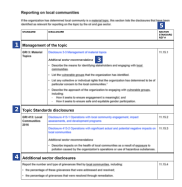
For each topic in section 2 of this Standard, a reporting sub-section is included. These sub-sections list disclosures from the GRI Topic Standards that are relevant to the topic. They may also list additional sector disclosures and recommendations for the organization to report. This is done in cases where the Topic Standards do not provide disclosures, or where the disclosures from the Topic Standards do not provide sufficient information about the organization’s impacts in relation to a topic. These additional sector disclosures and recommendations may be based on other sources. Figure 2 illustrates how the reporting included in each topic is structured.
The organization is required to report the disclosures from the Topic Standards listed for those topics it has determined to be material. If any of the Topic Standards disclosures listed are not relevant to the organization’s impacts, the organization is not required to report them. However, the organization is required to list these disclosures in the GRI content index and provide ‘not applicable’ as the reason for omission for not reporting the disclosures. See Requirement 6 in GRI 1: Foundation 2021 for more information on reasons for omission.
The additional sector disclosures and recommendations outline further information which has been identified as relevant for organizations in the agriculture, aquaculture, and fishing sectors to report in relation to a topic. The organization should provide sufficient information about its impacts in relation to each material topic, so that information users can make informed assessments and decisions about the organization. For this reason, reporting these additional sector disclosures and recommendations is encouraged, however it is not a requirement. When the organization reports additional sector disclosures, it is required to list them in the GRI content index (see Requirement 7 in GRI 1).
If the organization reports information that applies to more than one material topic, it does not need to repeat it for each topic. The organization can report this information once, with a clear explanation of all the topics it covers. If the organization intends to publish a standalone sustainability report, it does not need to repeat information that it has already reported publicly elsewhere, such as on web pages or in its annual report. In such a case, the organization can report on a required disclosure by providing a reference in the GRI content index as to where this information can be found (e.g., by providing a link to the web page or citing the page in the annual report where the information has been published). See Requirement 5 in GRI 1 for more information on using Sector Standards to report disclosures.
GRI Sector Standard reference numbers
GRI Sector Standard reference numbers are included for all disclosures listed in this Standard, both those from GRI Standards and additional sector disclosures. When listing the disclosures from this Standard in the GRI content index, the organization is required to include the associated GRI Sector Standard reference numbers (see Requirement 7 in GRI 1: Foundation 2021). This identifier helps information users assess which of the disclosures listed in the applicable Sector Standards are included in the organization’s reporting.
Defined terms
Defined terms are underlined in the text of the GRI Standards and linked to their definitions in the Glossary. The organization is required to apply the definitions in the Glossary.
References and resources
The authoritative intergovernmental instruments and additional references used in developing this Standard, as well as further resources that may help report on likely material topics and can be consulted by the organization are listed in the Bibliography. These complement the references and resources listed in GRI 3: Material Topics 2021 and in the GRI Topic Standards.
Figure 2. Structure of reporting included in each topic
|
|
Management of the topic Topic Standards disclosures Additional sector recommendations Additional sector disclosures Sector Standard reference numbers |
1. Sector profile
The agriculture, aquaculture, and fishing sectors produce essential food and non-food items, such as fibers, fuels, and rubber products. They play a major role in global development as a provider of food for human consumption and supplier of materials to other economic sectors, such as textiles, construction materials, pharmaceuticals, and the production of biofuels.
Production levels and value created by the sectors have increased in almost all countries across the globe in the past 20 years. However, their contribution to global gross domestic product (GDP) across this time period has stayed consistent at about 4%.2 Despite this relatively limited global economic contribution, the sector has an outsized impact in developing countries and on those in rural areas. In some developing countries, it accounts for more than a quarter of GDP [20].
Demand for the products of the sectors is projected to grow into the future, driven by a growing population and changes in income levels. Future production will also be influenced by demographic, socio-cultural, and lifestyle changes, as well as consumer awareness of health and sustainability issues [30].
Agriculture, aquaculture, and fishing operations can be formally or informally organized as large-scale or small-scale business enterprises. Operations can also include households, cooperatives, and government institutions. These organizations can own or operate farms, fishing vessels, mills, and hatcheries. Vertically integrated organizations can directly own or manage production, storage, processing, and distribution.
Sector activities and business relationships
Through their activities and business relationships, organizations can have an effect on the economy, environment, and people, and in turn make negative or positive contributions to sustainable development. When determining its material topics, the organization should consider the impacts of both its activities and its business relationships.
Activities
The impacts of an organization vary according to the types of activities it undertakes. The following list outlines some of the key activities of the agriculture, aquaculture, and fishing sectors, as defined in this Standard. This list is not exhaustive.
Crop production
Production: growing and harvesting seeds, trees for rubber and latex, and all crops, such as cereals, vegetables, fruits, fibers, and other types; gathering berries, nuts, mushrooms, and sap.
Primary processing: cleaning, grading, hulling, pounding, and milling grains; soaking, heating, and drying leaves; extracting and filtering oils.
Aggregation: aggregating crop produce from multiple sources at farm level for sale to downstream markets, which can involve transaction by intermediary organizations or single actors.
Storage: keeping crops in a way that preserves their quality and keeps them safe from, for example, molds, yeasts, and rodents.
Transportation: using traditional or mechanized transportation to move crops.
Trading: buying and selling crops.
Animal production
Production: breeding and rearing livestock and poultry; collecting live animal products, such as meat, milk, eggs, honey, and wool; farming insects; raising animals in captivity; feeding animals; operating animal farms.
Primary processing: cleaning and washing animal products; processing milk; candling eggs; slaughtering animals for meat; deboning, cutting, smoking, and freezing meat; separating fur, skins, feathers, and down.
Aggregation: aggregating animal products from multiple farms for sale to downstream markets, which can involve transaction by intermediary organizations or single actors.
Storage: keeping animal products in a way that preserves their quality and keeps them safe from, for example, harmful bacteria.
Transportation: using traditional or mechanized transportation to move live animals and animal products.
Trading: buying and selling live animals and animal products.
Aquaculture
Production: growing of algae and other seaweeds; culturing or farming of aquatic organisms, such as fish, mollusks, and crustaceans, in captive conditions that involve regular stocking, feeding, and protecting against predators; this includes both capture-based aquaculture (CBA) and hatchery-based aquaculture (HBA) systems.
Primary processing: slaughtering and deshelling produced aquatic organisms; undertaking service activities incidental to the operation of fish hatcheries and fish farms.
Aggregation: aggregating fish, mollusks, and crustaceans from multiple sources for sale to downstream markets, which can involve transaction by intermediary organizations or single actors.
Storage: keeping aquaculture products in a way that preserves their quality and keeps them safe from, for example, harmful bacteria.
Transportation: using traditional or mechanized transportation to move aquaculture products.
Trading: buying and selling aquaculture products.
Fishing
Fishing: capturing wild aquatic organisms, such as fish, mollusks, and crustaceans, via shore-based netting or commercial fishing vessels in inshore, coastal, or offshore waters.
Primary processing: onboard handling of live wild aquatic organisms after capture and through to the point of landing.
Aggregation: aggregating fish, mollusks, and crustaceans from multiple sources to downstream markets, which can involve transaction by intermediary organizations or single actors.
Storage: keeping fishing products3 in a way that preserves their quality and keeps them safe from, for example, harmful bacteria.
Transportation: using traditional or mechanized transportation to move fishing products.
Trading: buying and selling fishing products.
Business relationships
An organization’s business relationships include relationships that it has with business partners, with entities in its value chain, including those beyond the first tier, and with any other entities directly linked to its operations, products, or services. The following types of business relationships are prevalent in the agriculture, aquaculture, and fishing sectors and are relevant when identifying the impacts of organizations in the sectors.
Aggregators: intermediary organizations or single actors who bring products from multiple sources at farm, fishery, hatchery, or mill level for sale to downstream markets.
Animal or fish feed suppliers: organizations or persons that provide feed for animal production or aquaculture.
Primary producers: agriculture, aquaculture, and fishing organizations can often buy their products from primary producers who actively farm or fish. Primary producers can be other organizations or persons, such as farmers and fishers, categorized as self-employed workers.
Suppliers of agricultural inputs: organizations that produce and sell fertilizers, pesticides and other inputs, and seeds.
The sectors and sustainable development
Agriculture, aquaculture, and fishing are fundamental to feeding the world’s population. The sectors have a key role in meeting the growing demand for nutritious, affordable, and safe food for an estimated 10 billion people by 2050 [30]. At the same time, these sectors’ activities are increasingly recognized as having significant impacts on sustainable development. Intensive use of natural resources, the location of operations in rural areas, and large amounts of labor involved into production globally are factors contributing to the scale of the sectors’ impacts.
The agriculture, aquaculture, and fishing sectors are the second largest source of employment worldwide [20].4 Over 2.5 billion people living in rural areas depend on them these sectors for jobs. At the same time, agriculture, aquaculture, and fishing are sectors with the highest informality rates in employment contracts, commercial transactions, and land tenure, posing challenges to upholding human rights. With 80% of the world’s poor living in rural areas, ensuring sufficient income for rural workers remains an issue [37]. Improving incomes means communities need better economic opportunities, access to technology, skills training, and a more equitable distribution of value created by their labor. Growth in the sectors is proportionately more effective in raising the incomes of the world’s poorest people in comparison to other sectors.
Agriculture, aquaculture, and fishing have a substantial environmental footprint. For example, agriculture accounts for an estimated 70% of freshwater withdrawals globally and is a substantial source of greenhouse gas (GHG) emissions, accounting for 22% of the total global emissions [25].5 Similarly, fishing is responsible for at least 1.2% of global oil consumption [10].
Because agriculture, aquaculture, and fishing production rely on biodiversity, soils, and ecosystems, implementing sustainable practices across the sectors is a fundamental condition for food security. However, the agriculture sector is associated with 70% of losses in terrestrial biodiversity because of land conversion, deforestation, soil erosion, and impacts of pesticides [21]. Fishing has resulted in significant impacts on global ocean biodiversity, with one-third of fish stocks being overfished and about 60% fished at their maximum sustainable levels [24].
There has been ongoing growth in the global consumption of animal and aquaculture products. With approximately 340 million tons of meat, 88 million tons of dairy and 85 million tons of aquaculture products being produced annually, animal health and welfare are fundamental to agriculture and aquaculture activities [20]. The conditions animals live in have considerable implications for preventing zoonotic disease and the risks of antimicrobial resistance. Sound animal health and welfare also mean the responsibility for treating animals humanely.
Climate change poses challenges for the agriculture, aquaculture, and fishing sectors. It can affect yields, disrupt production and supply chains, jeopardizing food security. Impacts of climate change can also deepen poverty levels, displace people from their lands, and thus increase migration. Agriculture, aquaculture, and fishing organizations can contribute to food security and global development by building resilience to climate change, reducing food loss, and providing income and livelihoods to farmers and fishers and their communities.
Sustainable Development Goals
The Sustainable Development Goals (SDGs), part of the 2030 Agenda for Sustainable Development adopted by the 193 United Nations (UN) member states, comprise the world’s comprehensive plan of action for achieving sustainable development [7].
Since the SDGs and the targets associated with them are integrated and indivisible, agriculture, aquaculture, and fishing organizations have the potential to contribute to all SDGs by enhancing their positive impacts or by preventing and mitigating their negative impacts on the economy, environment, and people.
The agriculture, aquaculture, and fishing sectors provide food for communities across the world and are best positioned to contribute to Goal 2: Zero Hunger. The sectors are also the world’s biggest employers and the largest economic sectors for many countries, directly impacting Goal 1: No Poverty and Goal 8: Decent Work and Economic Growth.
By managing natural resources sustainably and efficiently (Goal 12: Responsible Consumption and Production), agriculture has the potential to revitalize rural landscapes, contributing to Goal 15: Life on land. At the same time, the aquaculture and fishing sectors can contribute to healthy marine and aquatic ecosystems, which is Goal 14: Life Below Water. By implementing resilient fishing and farming practices, the agriculture, aquaculture, and fishing sectors can help increase productivity and build the adaptive capacity to respond to climate change (Goal 13: Climate Action).
Table 2 presents connections between the likely material topics for the agriculture, aquaculture, and fishing sectors and the SDGs. These linkages were identified based on an assessment of the impacts described in each likely material topic, and the targets associated with each SDG.
Table 2 is not a reporting tool but presents connections between the agriculture, aquaculture, and fishing sectors’ significant impacts and the goals of the 2030 Agenda for Sustainable Development. See references [40] and [41] in the Bibliography for information on reporting progress towards the SDGs using the GRI Standards.
Table 2: Linkages between the likely material topics for the agriculture, aquaculture, and fishing sectors and the SDGs.
 |
 |
 |
 |
 |
 |
 |
 |
 |
 |
 |
 |
 |
 |
 |
 |
 |
|
| Topic 13.1 Emissions |  |
 |
 |
 |
 |
 |
|||||||||||
| Topic 13.2 Climate adaptation and resilience |  |
 |
 |
||||||||||||||
| Topic 13.3 Biodiversity | |
 |
|
|
|
||||||||||||
| Topic 13.4 Natural ecosystem conversion | |
|
|
||||||||||||||
| Topic 13.5 Soil health | |
|
|||||||||||||||
| Topic 13.6 Pesticides use | |
|
 |
|
|
||||||||||||
| Topic 13.7 Water and effluents | |
|
|
||||||||||||||
| Topic 13.8 Waste | |
||||||||||||||||
| Topic 13.9 Food security | |
 |
|||||||||||||||
| Topic 13.10 Food safety | |
|
|||||||||||||||
| Topic 13.11 Animal health and welfare | |
||||||||||||||||
| Topic 13.12 Local communities | |
|
|
 |
|
|
 |
||||||||||
| Topic 13.13 Land and resource rights |  |
|
 |
|
|
|
|||||||||||
| Topic 13.14 Rights of indigenous peoples | |
|
|
 |
|
|
|
||||||||||
| Topic 13.15 Non-discrimination and equal opportunity | |
|
|
|
|||||||||||||
| Topic 13.16 Forced or compulsory labor | |
|
|
||||||||||||||
| Topic 13.17 Child labor | |
|
|
||||||||||||||
| Topic 13.18 Freedom of association and collective bargaining | |
|
|||||||||||||||
| Topic 13.19 Occupational health and safety |  |
|
|||||||||||||||
| Topic 13.20 Employment practices | |
|
|
||||||||||||||
| Topic 13.21 Living income and living wage | |
|
|
|
|||||||||||||
| Topic 13.22 Economic inclusion | |
|
|
|
 |
|
 |
|
|||||||||
| Topic 13.23 Supply chain traceability | |
|
|
||||||||||||||
| Topic 13.24 Public policy | |
|
|
|
|||||||||||||
| Topic 13.25 Anti-competitive behavior | |
||||||||||||||||
| Topic 13.26 Anti-corruption | |
2. Likely material topics
This section comprises the likely material topics for the agriculture, aquaculture, and fishing sectors. Each topic describes the sectors’ most significant impacts related to the topic and lists disclosures that have been identified as relevant for reporting on the topic by agriculture, aquaculture, and fishing organizations. The organization is required to review each topic in this section and determine whether it is a material topic for the organization, and then to determine what information to report for its material topics.
Topic 13.1 Emissions
This topic addresses emissions into the air, including greenhouse gas (GHG), ozone-depleting substances (ODS), nitrogen oxides (NOX), sulfur oxides (SOX), and other significant air emissions regarded as pollutants. Emissions can have negative impacts on air quality, ecosystems, and on human and animal health. GHG emissions are also a major contributor to climate change.
Agriculture is responsible for a large portion of greenhouse gas (GHG) emissions. From 2007 to 2016, the sector accounted for approximately 13% of carbon dioxide (CO2), 44% of methane (CH4), and 82% of nitrous oxide (N2O) emissions from human activities globally, which was 23% of the total net anthropogenic emissions of GHGs over this period [46].
In agriculture and aquaculture, the highest share of total emissions is associated with land use change, including the conversion of land from a natural ecosystem for use by the sectors [46] (see also topic 13.4 Natural ecosystem conversion). Forests contribute to the reduction of CO2 by absorbing more carbon than they release, making them a carbon sink. Clearing forests or grasslands results in large amounts of CO2 being released. Soils can also absorb greenhouse gas emissions. Soil and pasture management practices can contribute to the capacity of soil to store carbon or adversely accelerate the release of carbon from the soil into the atmosphere (see topic 13.5 Soil health). Restoring and preserving carbon sinks, such as natural ecosystems and soils, plays an integral role in mitigating climate change (see also topic 13.2 Climate adaptation and resilience).
Land management for crop production produces GHG emissions through soil cultivation, including tillage, crop residue decomposition, and burning vegetation and crop residues. This results in the production of CO2, N2O, and particulate matter. Fertilizers, pesticides, and fuels used to power machinery and vehicles also release GHG emissions.
Ruminant livestock produce GHG emissions during respiration and digestion. Animal manure also emits gases, such as CH4, N2O, and CO2. Livestock on managed pastures and rangelands was estimated accounted for over half of total anthropogenic N2O emissions from agriculture [46]. CH4 and N2O emissions have a higher global warming potential than CO2.
In animal production and aquaculture, emissions are also associated with animal and fish feed sourcing. These emissions can be caused by natural ecosystem conversion and the feed's production, processing, and transportation. In aquaculture land-based farms, emissions are also released from the combustion of fuel to generate the energy needed to regulate water temperature and circulation.
Fishing activities produce emissions from burning fuels, such as diesel, marine fuel oils, and intermediate fuel oils. These fuels provide the power to fishing vessels to access marine stocks and power onboard fish processing facilities, including freezing or refrigerating fish. Fishing vessels are not necessarily optimized for fuel efficiency, further contributing to emissions. The combustion of fuels also produces localized air pollution, while the use of refrigerants to store fish products can result in the emission of ozone-depleting substances.
The goal of the Paris Agreement to limit global warming to well below 2°C requires organizations to set emissions targets consistent with the cumulative carbon budgets that set a cap for the total allowed CO2 emissions [42].
Reducing emissions for the sectors includes measures that help mitigate the main sources of GHGs, for example, measures to reduce methane (CH4) emitted by ruminants through better management of feed and manure, or in crop production, using culture-specific production practices, such as growing rice using alternate wetting and drying methods that reduce methane production.
Reporting on emissions
If the organization has determined emissions to be a material topic, this sub-section lists the disclosures identified as relevant for reporting on the topic by the agriculture, aquaculture, and fishing sectors.
| STANDARD | DISCLOSURE | SECTOR STANDARD REF. NO. |
| Management of the topic | ||
| GRI 3: Material Topics 2021 | 13.1.1 | |
| Topic Standard disclosures | ||
| GRI 305: Emissions 2016 |
Disclosure 305-1 Direct (Scope 1) GHG emissions Additional sector recommendations
|
13.1.2 |
| 13.1.3 | ||
|
Disclosure 305-3 Other indirect (Scope 3) GHG emissions Additional sector recommendations
|
13.1.4 | |
| 13.1.5 | ||
| 13.1.6 | ||
|
Disclosure 305-6 Emissions of ozone-depleting substances (ODS) |
13.1.7 | |
|
Disclosure 305-7 Nitrogen oxides (NOX), sulfur oxides (SOX), and other significant air emissions |
13.1.8 | |
References and resources
GRI 305: Emissions 2016 lists authoritative intergovernmental instruments and additional references relevant to reporting on this topic.
The additional references used in developing this topic, as well as resources that may be helpful for reporting on emissions by the agriculture, aquaculture, and fishing sectors are listed in the Bibliography.
Topic 13.2 Climate adaptation and resilience
Organizations contribute to climate change and are simultaneously affected by it. Climate adaptation and resilience refer to how an organization adjusts to current and anticipated climate change-related risks, as well as how it contributes to the ability of societies and economies to withstand impacts from climate change.
Major impacts of climate change include an increase in acute weather events and long-term shifts in climate patterns. As a consequence, crop yields and biogeographic suitability have been negatively impacted in recent decades.
In agriculture, crops can be damaged and harvests lost due to increased volatility, intensity, and duration of weather-related events. Warmer winters related to climate change affect fruits and vegetables that need a period of colder weather to produce viable harvests. Land degradation exacerbated by global warming can also lead to increased frequency and severity of flooding, drought, pest prevalence, diseases, heat stress, dry spells, wind, sea-level rise, wave action, and permafrost thaw.
Aquaculture and fishing operations are likely to be affected by water temperature increases, oxygen deficit, sea-level rise, decreased pH levels, and changes in productivity patterns. Higher ocean temperatures also means continued losses of marine habitats and species. Aquaculture and inland fishing activities are also affected by changes in precipitation and water management, increased stress on freshwater resources, and the frequency and intensity of extreme climate events. In tropical and less developed regions, small-scale fishers are particularly vulnerable to climate change-related impacts.
An organization’s failure to adapt to climate change-related impacts can lead to disruptions in operations, increased occupational health and safety impacts, loss of livelihood, and food insecurity. These disruptions can affect an organization's workers, suppliers, customers, as well as smallholder farmers, fishers, indigenous peoples, and local communities. Disruptions in food production mean that between 34 and 600 million more people could suffer from hunger by 2080, depending on how climate change-related scenarios unfold [53] (see also topic 13.9 Food security).
Organizations can respond to climate change impacts by adopting practices and technologies that build resilience. For example, in agriculture, low or no-till farming can reduce soil erosion, leading to improved soil and water quality. Another important adaptation strategy for the sectors is the diversification in production through a wider genetic base with improvements in the tolerance of heat and drought. Mitigating food loss (see also topic 13.9 Food security) is another measure that contributes to less land and natural resources needed to produce the same output, thereby reducing GHG emissions.
Preserving indigenous and local knowledge of biodiversity can also be a contributing factor in enhancing climate resilience. Indigenous and local knowledge often focuses on preserving ecosystems and offers adaptive strategies to cope with unfavorable conditions in local areas.
Reporting on climate adaptation and resilience
If the organization has determined climate adaptation and resilience to be a material topic, this sub-section lists the disclosures identified as relevant for reporting on the topic by the agriculture, aquaculture, and fishing sectors.
| STANDARD | DISCLOSURE | SECTOR STANDARD REF. NO. |
| Management of the topic | ||
| GRI 3: Material Topics 2021 | 13.2.1 | |
| Topic Standard disclosures | ||
|
GRI 201: Economic Performance 2016 |
Disclosure 201-2 Financial implications and other risks and opportunities due to climate change Additional sector recommendations
|
13.2.2 |
References and resources
GRI 201: Economic Performance 2016 lists authoritative intergovernmental instruments and additional references relevant to reporting on this topic.
The additional references used in developing this topic, as well as resources that may be helpful for reporting on climate adaptation and resilience by the agriculture, aquaculture, and fishing sectors are listed in the Bibliography.
Topic 13.3 Biodiversity
Biodiversity is the variability among living organisms. It includes diversity within species, between species and of ecosystems. Biodiversity not only has intrinsic value, but is also vital to human health, food security, economic prosperity, and mitigation of climate change and adaptation to its impacts. This topic covers impacts on biodiversity, including on plant and animal species, genetic diversity, and natural ecosystems.
Biodiversity is essential for food production and a wide range of ecosystem services. According to the International Union for Conservation of Nature (IUCN), biodiversity faces five major threats: habitat loss and degradation, overexploitation of biological resources, pollution, climate change, and invasive species.
Agriculture, aquaculture, and fishing operations pose threats to biodiversity through air, soil, and water contamination, deforestation, soil erosion, sedimentation of waterways, and species extraction. Biodiversity generally declines as agriculture, aquaculture, or fishing activities intensify. This is largely driven by natural ecosystem conversion and habitat change (see also topic 13.4 Natural ecosystem conversion). Biodiversity impacts result in increased mortality rates of species, habitat fragmentation, and can lead to species loss or extinction.
Biodiversity can be adversely impacted by monoculture. Growing the same crops or rearing the same animal species year after year may increase production but it also decreases agrobiodiversity on farms and plantations and can compromise biodiversity in adjacent environments. In crop production, continuous monocropping can result in a buildup of pests and diseases, usually requiring higher volumes of pesticides, which can be toxic to many non-target species, including pollinators. About 40% of invertebrate pollinator species, particularly bees and butterflies, face extinction [71].
Animal production can be a major source of surplus nitrogen and phosphorous pollution, leading to eutrophication in adjacent lakes and rivers, rendering them uninhabitable for aquatic organisms (see also topic 13.7 Water and effluents). Aquaculture activities have similar impacts due to a buildup of fish excrement in waterbodies. These impacts can adversely affect the availability of fishery resources and food for local communities.
Aquaculture can also result in impacts on local biodiversity through escapes from aquaculture farms, which in turn can compete with the area’s native species. Poor feeding practices can result in excess or insufficient feed for fish, adding to disease outbreaks and aquatic pollution. The presence of extra feed can attract wild fish and predators to the water column.
Fishing is one of the most significant drivers of declining ocean biodiversity. This is largely due to overfishing, by-catch, and illegal, unreported, and unregulated fishing (IUU). From 1974 to 2017, the proportion of the world’s fish stocks classified as overfished increased to 34.2%, with only about two-thirds of global fish stocks deemed as biologically sustainable (see references [65] and [68]).
Overfishing leads to impacts on the biodiversity of marine ecosystems by altering the composition of species. These alterations result in impacts on predator-prey relationships and cause shifts in trophic structures. Overfishing can be harder to prevent in international waters, where efforts to manage stock sustainably are further complicated when fish move across country borders.
Fishmeal and fish oil are rich in protein and are typically used as fish and animal feed ingredients. Fishing products used for feed can be derived from forage fish or fishing by-products, including trimmings and offcuts. Overfishing forage fish stocks used for feed increases pressure on the wild trophic structures. In aquaculture, further pressure on fish stocks can also be driven by using juvenile seeds captured in the wild.
Certain fishing practices, for example, bottom trawling in areas of high biodiversity value, can damage the seabed’s physical structure, affecting bottom plants, corals, sponges, fish, and other aquatic animals. This practice can profoundly change how natural benthic ecosystems function or lead to their destruction. Seabed damage can also result in carbon dioxide (CO2) emissions.
A phenomenon known as ‘ghost fishing’ can threaten both target and non-target species, potentially killing endangered and protected species and damaging underwater habitats. This phenomenon occurs when fishing gear is lost or discarded and can continue to trap species indiscriminately. Lost or discarded fishing gear also contributes to marine plastic pollution (see also topic 13.8 Waste).
About 80% of terrestrial biodiversity is found in indigenous peoples’ lands and forests [76]; respecting indigenous peoples’ rights to land and natural resources can also make a profound contribution to biodiversity conservation (see topic 13.14 Rights of indigenous peoples and topic 13.13 Land and resource rights).
Reporting on biodiversity
If the organization has determined biodiversity to be a material topic, this sub-section lists the disclosures identified as relevant for reporting on the topic by the agriculture, aquaculture, and fishing sectors.
| STANDARD | DISCLOSURE | SECTOR STANDARD REF. NO. |
| Management of the topic | ||
| GRI 3: Material Topics 2021 |
Disclosure 3-3 Management of material topics Additional sector recommendations The following additional sector recommendation is for organizations in the aquaculture sector:
|
13.3.1 |
| Topic Standard disclosures | ||
|
GRI 304: Biodiversity 2016 |
13.3.2 | |
|
Disclosure 304-2 Significant impacts of activities, products and services on biodiversity |
13.3.3 | |
| 13.3.4 | ||
| Disclosure 304-4 IUCN Red List species and national conservation list species with habitats in areas affected by operations | 13.3.5 | |
| Additional sector disclosures | ||
|
The following additional sector disclosures are for organizations in the aquaculture sector:
|
13.3.6 | |
|
The following additional sector disclosure is for organizations in the fishing sector:
|
13.3.7 | |
References and resources
GRI 304: Biodiversity 2016 lists authoritative intergovernmental instruments and additional references relevant to reporting on this topic.
The additional authoritative instruments and references used in developing this topic, as well as resources that may be helpful for reporting on biodiversity by the agriculture, aquaculture, and fishing sectors are listed in the Bibliography.
Topic 13.4 Natural ecosystem conversion
Natural ecosystem conversion refers to changing a natural ecosystem to another use or a profound change in a natural ecosystem’s species composition, structure, or function. This topic covers impacts related to natural ecosystem conversion, including discrete incidents of land clearance, severe degradation, or the introduction of practices that lead to substantial and sustained change in natural ecosystems.
Natural ecosystems offer important services, including absorbing and storing vast quantities of carbon dioxide (CO2). When natural ecosystems are converted to other uses, stored carbon can be released into the atmosphere, contributing to greenhouse gas (GHG) emissions and climate change. Estimates show that the loss of primary tropical forests in 2019 resulted in the release of more than 2 billion tons of CO2 [86] (see topic 13.1 Emissions and topic 13.2 Climate adaptation and resilience). Conversion of natural ecosystems can also lead to other environmental impacts, such as loss of biodiversity (see also topic 13.3 Biodiversity), acceleration of soil erosion (see also topic 13.5 Soil health), and increased runoff and water pollution (see also topic 13.7 Water and effluents).
In agriculture and aquaculture sectors, natural ecosystem conversion can occur through the use of land and aquatic environments for animal breeding, grazing, crop production, aquaculture production, and ancillary activities. This can occur rapidly, with a significant change taking place in a short time, or gradually, with incremental changes over a long time.
Terrestrial ecosystem conversion can include the conversion of forests through deforestation and the conversion of other ecosystems, such as grasslands, woodlands, or savannas. Deforestation occurs when primary and secondary forests are cleared, often by burning. Deforestation in tropical rainforests can have a particularly severe impact because they are habitat to much of the world's biodiversity.
Aquaculture operations can result in clearing mangroves, salt marshes, and wetlands or produce sustained changes to the coastal, lake, and river ecosystems to make them fit for aquatic farming sites. Aquaculture also relies heavily on crops, such as soy, for fish feed which can contribute to the conversion of terrestrial ecosystems. Feed ingredients need to be traceable to identify and prevent the potential negative impacts associated with conversion (see topic 13.23 Supply chain traceability).
The rate of deforestation and conversion in the agriculture sector has been increasing to give way to plantations and pastures [91]. Deforestation and conversion occur in the supply chains of beef, soy, palm oil, cocoa, coffee, rubber, and other products. To be deemed deforestation- and conversion-free, products must be assessed as not causing or contributing to natural ecosystem conversion after an appropriate cut-off date.9
People can be displaced due to physical changes to the landscapes surrounding their communities or degradation or depletion of natural resources or ecosystem services that the community relies on (see also topic 13.12 Local communities and topic 13.13 Land and resource rights). Loss of natural ecosystems and resources can also cause food insecurity. For indigenous peoples, natural ecosystem conversion can result in the loss of cultural and spiritual heritage and livelihoods and impact the rights to self-determination and self-governance (see also topic 13.14 Rights of indigenous peoples).
Reporting on natural ecosystem conversion
If the organization has determined natural ecosystem conversion to be a material topic, this sub-section lists the disclosures identified as relevant for reporting on the topic by the agriculture, aquaculture, and fishing sectors.
| STANDARD | DISCLOSURE | SECTOR STANDARD REF. NO. |
| Management of the topic | ||
| GRI 3: Material Topics 2021 |
Disclosure 3-3 Management of material topics Additional sector recommendations
|
13.4.1 |
| Additional sector disclosures | ||
| Report the percentage of production volume from land owned, leased or managed by the organization determined to be deforestation- or conversion-free, by product, and describe the assessment methods used.13 | 13.4.2 | |
|
13.4.3 | |
| Report the size in hectares, the location, and the type14 of natural ecosystems converted since the cut-off date on land owned, leased, or managed by the organization. | 13.4.4 | |
| Report the size in hectares, the location, and the type of natural ecosystems converted since the cut-off date by suppliers or in sourcing locations. | 13.4.5 | |
References and resources
The authoritative instruments and references used in developing this topic, as well as resources that may be helpful for reporting on natural ecosystem conversion by the agriculture, aquaculture, and fishing sectors are listed in the Bibliography.
Topic 13.5 Soil health
Soil health is the capacity of soil to function as a living ecosystem and to sustain plant and animal productivity, promote plant and animal health, and maintain or enhance water and air quality. This topic covers impacts on soil health, including soil erosion, soil loss, and reduction in soil fertility.
Recent estimates suggest that 80% of agricultural land is affected by moderate to severe erosion [97]. Although soil erosion occurs naturally, agricultural activities can significantly accelerate this process by removing vegetation cover, tillage, soil compaction, irrigation, and overgrazing by livestock.
In agriculture, original vegetation cover is removed to make land available for crop production or animal grazing. Agricultural crops rarely hold onto the topsoil as well as the original vegetation cover, increasing soil erosion and potentially reducing soil fertility. Estimates show that half of the topsoil globally has been lost in the past 150 years [102]. Grazing livestock can also cause impacts on soil structure through excessive defoliation, defecation, and trampling.
Soil erosion can also be accelerated by tillage. Soil erosion in agricultural fields exceeds soil formation at rates estimated between 10 to 20 times higher when there is no tillage and over 100 times higher when conventional tillage is used [101]. The increased erosion is because conventional tillage inverts and breaks up the soil, destroys the soil structure, and buries crop residues. Tilled soils have less capacity to support loads applied to the ground and are consequently more sensitive to compaction caused by agricultural machinery, which can lead to impacts on soil biodiversity. Minimum till or no-till methods, which reduce tillage area and tillage depth, crop protection, and other soil management practices, can help to reduce soil erosion.
Fertilizers, both organic and inorganic, as well as pesticides, have an impact on soil health (see also topic 13.6 Pesticides use). Excessive use of inorganic fertilizers can increase soil acidity levels and alter soil fertility. Pesticides can affect soil communities by influencing the performance of soil biota or modifying it. This can compromise the abundance and composition of the entire soil food web.
The main ingredients of fertilizers commonly used in agriculture are nitrogen, phosphorus, and potassium. The presence of phosphorus in agricultural runoff can accelerate eutrophication. Alterations to the global nitrogen cycle can lead to the rise of nitrous oxide levels in the atmosphere. Excessive use of nitrogen fertilizers in agriculture has been a major source of nitrate pollution in groundwater and surface water affecting access to clean water for local communities.
Reporting on soil health
If the organization has determined soil health to be a material topic, this sub-section lists the disclosures identified as relevant for reporting on the topic by the agriculture, aquaculture, and fishing sectors.
| STANDARD | DISCLOSURE | SECTOR STANDARD REF. NO. |
| Management of the topic | ||
| GRI 3: Material Topics 2021 |
Disclosure 3-3 Management of material topics Additional sector recommendations
|
13.5.1 |
References and resources
The authoritative instruments and references used in developing this topic, as well as resources that may be helpful for reporting on soil health by the agriculture, aquaculture, and fishing sectors are listed in the Bibliography.
Topic 13.6 Pesticides use
Pesticides are chemical or biological substances intended to regulate plant growth or control, repel, or destroy any pest. This topic covers an organization’s approach and impacts related to pesticides use, including the impact of their toxicity on non-target organisms.
Pesticides include herbicides, insecticides, fungicides, nematicides, and rodenticides and can be used in crop production to control weeds and other pests.15 Pesticides can decrease the spread of diseases and pests, increase production yields, and potentially limit the need to convert more land.
Conversely, if not handled properly pesticides can induce adverse health effects in humans by interfering with reproduction, immune, and nervous systems. Pesticides can also have negative impacts on biodiversity because of their toxicological effects. For example, pesticides that target insects or weeds can be toxic to birds, fish, and non-target plants and insects. These impacts can threaten ecosystem services, such as pollination, and adversely impact food security and people’s livelihoods (see also topic 13.3 Biodiversity).
Each pesticide has different properties and toxicological effects. The World Health Organization (WHO) classifies the toxicity hazard levels for pesticides as either extremely hazardous, highly hazardous, moderately hazardous, slightly hazardous, or unlikely to present an acute hazard. Toxicity depends on the pesticide’s function and other factors, such as its use and disposal. The regulation of pesticides is not always consistent across the world. Some pesticides, usually those classified as extremely and highly hazardous, are unregistered or banned in some countries but may remain available in others.
Workers and other people in the immediate area have the potential to be most affected during or right after pesticides are applied. Pesticides can also stay in soil and water for years and have long-term negative impacts on local communities and the local environment (see also topic 13.8 Waste). Women and children can be particularly vulnerable to negative health effects caused by exposure to pesticides (see topic 13.12 Local communities and also topic 13.19 Occupational health and safety). Exposure to pesticide residue is also possible through food and water (see also topic 13.7 Water and effluents and topic 13.10 Food safety).
The Food and Agriculture Organization (FAO) estimates that in developing countries, 80% of the increase in food production needed to keep pace with population growth is projected to come from greater crop yields. This could trigger a further intensification of pesticide use to generate higher yields. The intensive use of pesticides sometimes leads to resistance and outbreaks of secondary pests.
Integrated pest management in agriculture seeking to optimize pest control and mitigate negative impacts is a widely recognized approach that considers biological, chemical, physical, and crop-specific pest control practices. When pest control through the application of chemicals cannot be avoided, organizations are expected to manage pesticide use to minimize negative impacts and the application of extremely and highly hazardous pesticides [105].
Reporting on pesticides use
If the organization has determined pesticides use to be a material topic, this sub-section lists the disclosures identified as relevant for reporting on the topic by the agriculture, aquaculture, and fishing sectors.
| STANDARD | DISCLOSURE | SECTOR STANDARD REF. NO. |
| Management of the topic | ||
| GRI 3: Material Topics 2021 |
Disclosure 3-3 Management of material topics Additional sector recommendations
|
13.6.1 |
| Additional sector disclosures | ||
|
13.6.2 | |
References and resources
The authoritative instruments and references used in developing this topic, as well as resources that may be helpful for reporting on pesticides use by the agriculture, aquaculture, and fishing sectors are listed in the Bibliography.
Topic 13.7 Water and effluents
Recognized as a human right, access to fresh water is essential for human life and well-being. The amount of water withdrawn and consumed by an organization and the quality of its discharges can have impacts on ecosystems and people. This topic covers impacts related to the withdrawal and consumption of water and the quality of water discharged.
Water is a critical input for crop and animal production, as well as aquaculture. The agriculture sector accounts for an estimated 70% of total water withdrawn globally [120]. In crop production, withdrawn water is primarily used to irrigate land, apply pesticides and fertilizers, and control crop cooling and frost.
Water has critical importance to agricultural productivity. On average, irrigated land is twice as productive per unit as non-irrigated land. Irrigation can be achieved through different methods, including surface irrigation or subsurface irrigation. Water can be withdrawn from groundwater or surface water, such as lakes and reservoirs, or come in the form of treated wastewater or desalinated water. Intensive water withdrawal can decrease aquifer levels, which reduces the long-term sustainability of water resources and increases access costs for all users (see also topic 13.12 Local communities).
In animal production, water is used for animal hydration and cleaning. It is also used for the washing and sanitization of milking and slaughter equipment used to process animal products. Effluents containing waste from terrestrial animals, fertilizers, and pesticides can contribute to the pollution of surface and groundwater.
Aquaculture water use is associated with raising aquatic organisms in water and can require significant amount of surface water. Aquaculture production occurs in ponds, artificial channels, and, to a lesser extent, closed-recirculation tanks. Because aquaculture operations take place in controlled environments, much of the water withdrawn can be returned to the source after use.
Nutrient buildup from discharges in water bodies near fish farms is a typical water impact from aquaculture production. This issue is exacerbated in high-density farms when fish feces discharged into water potentially deplete oxygen levels and create algal blooms that lead to eutrophication. The eutrophication and acidification of water results in negative impacts on biodiversity. Water quality affects habitat and food sources for animals. Contaminated water can also adversely affect people’s access to clean water, compromising their health and livelihoods.
In fishing operations, wastewater can be discharged to the sea from fishing vessels. This includes water used to store fish aboard the vessel, which can contain fish waste from gutting and bleeding, as well as materials and coating from the hold and onboard refrigeration systems. Wastewater could also come from cleaning holds and machinery containing detergents, disinfectants and oily mixtures. Discharges can cause oxygen depletion in sea water and pollution in coastal areas.17
Reporting on water and effluents
If the organization has determined water and effluents to be a material topic, this sub-section lists the disclosures identified as relevant for reporting on the topic by the agriculture, aquaculture, and fishing sectors.
| STANDARD | DISCLOSURE | SECTOR STANDARD REF. NO. |
| Management of the topic | ||
| GRI 3: Material Topics 2021 | 13.7.1 | |
| Topic Standard disclosures | ||
|
GRI 303: Water and Effluents 2018 |
Disclosure 303-1 Interactions with water as a shared resource | 13.7.2 |
| Disclosure 303-2 Management of water discharge-related impacts | 13.7.3 | |
| Disclosure 303-3 Water withdrawal | 13.7.4 | |
| Disclosure 303-4 Water discharge | 13.7.5 | |
| Disclosure 303-5 Water consumption | 13.7.6 | |
References and resources
GRI 303: Water and Effluents 2018 lists authoritative intergovernmental instruments and additional references relevant to reporting on this topic.
The additional references used in developing this topic, as well as resources that may be helpful for reporting on water and effluent by the agriculture, aquaculture, and fishing sectors are listed in the Bibliography.
Topic 13.8 Waste
Waste refers to anything that a holder discards, intends to discard, or is required to discard. When inadequately managed, waste can have negative impacts on the environment and human health, which can extend beyond the locations where waste is generated and discarded. This topic covers impacts from waste and the management of waste.
Waste from organizations in the agriculture, aquaculture, and fishing sectors includes organic waste, such as crop waste, animal manure, fish feces, animal carcasses; and inorganic waste, such as plastics. It can also include hazardous waste, such as pesticides containers, and materials from animal health products.
Some organic by-products have the potential to be used as a biomass energy source, feed or fertilizers, contributing to circularity measures. For example, trimmings and offcuts from aquaculture and fishing operations can be turned into fishmeal and oil, while manure produced by animals is an organic fertilizer that can improve soil health. However, if incinerated without energy recovery or directed to landfills, by-products turn into waste and cause negative environmental impacts, including greenhouse gas (GHG) emissions and water pollution (see also topic 13.1 Emissions, topic 13.7 Water and effluents). In addition, organic waste from terrestrial and aquatic animals may contain microorganisms and parasite eggs. These pathogens can spread in receiving environments and cause ill health in humans.
In aquaculture operations, fish feed and feces can settle at the bottom of ponds or in inactive zones of raceways as liquid or solid organic waste. Fish feces may also reach and pollute waterbodies. Pollution and waste impacts from fish feces and settleable solids can be minimized through water management (see also topic 13.7 Water and effluents).
Aquaculture activities generate considerable amounts of plastic waste. Plastics are widely used for equipment, disposable gloves, and for packaging various inputs, such as feed sacks and wrapped consumables. Plastic can also be used in pond liners, harvest nets, pipework, buoys, ropes, incubation jars, and containers. In fishing, various marine tools, such as floats, fishing nets and lines, strapping bands, wire ropes, and sails, also consist of plastics.
Discarded or abandoned plastic waste can contaminate the surrounding environments and enter the ocean and other waterbodies. Abandoned, lost, or otherwise discarded fishing gear contributes to waste and overfishing (see also topic 13.3 Biodiversity). Fish and aquatic animals sometimes mistake plastic waste for food and get trapped in items such as ropes, nets, and bags. The management of waste generated onboard fishing vessels, including plastics, paper products, food waste, and chemicals, is regulated by international maritime standards (see references [125], [126] and [127]).
Incorrectly disposed waste from agriculture, aquaculture and fishing activities can have lasting impacts on receiving environments, causing long-term contamination of soil and water. Contamination of agricultural land and natural resources causes negative impacts on the health and safety of local communities and can impact the safety of food produced (see also topic 13.10 Food safety, topic 13.12 Local communities, and topic 13.14 Rights of indigenous peoples).
Reporting on waste
If the organization has determined waste to be a material topic, this sub-section lists the disclosures identified as relevant for reporting on the topic by the agriculture, aquaculture, and fishing sectors.
| STANDARD | DISCLOSURE | SECTOR STANDARD REF. NO. |
| Management of the topic | ||
| GRI 3: Material Topics 2021 | 13.8.1 | |
| Topic Standard disclosures | ||
| GRI 306: Waste 2020 |
Disclosure 306-1 Waste generation and significant waste-related impacts |
13.8.2 |
|
Disclosure 306-2 Management of significant waste-related impacts |
13.8.3 | |
|
Disclosure 306-3 Waste generated Additional sector recommendations The following additional sector recommendations are for organizations in the fishing sector:
|
13.8.4 | |
| 13.8.5 | ||
| 13.8.6 | ||
References and resources
GRI 306: Waste 2020 lists authoritative intergovernmental instruments and additional references relevant to reporting on this topic.
The additional references used in developing this topic, as well as resources that may be helpful for reporting on waste by the agriculture, aquaculture, and fishing sectors are listed in the Bibliography.
Topic 13.9 Food security
Food security means that people have physical and economic access to sufficient, safe, and nutritious food that is acceptable within a given culture and meets people’s dietary needs and food preferences for an active and healthy life. Adequate food is a human right and is crucial to the enjoyment of all rights. This topic covers impacts on the dimensions of food security.19
Food insecurity is a prevalent global issue. In 2018, more than 820 million people faced hunger, and as populations grow, global food needs will increase [147]. Many people cannot afford food or are forced to consume insufficient or low-quality food. Since 2014, undernourishment and food insecurity have consistently increased, putting global goals to end hunger at risk [146].
Agriculture, aquaculture, and fishing organizations have impacts on food supply and affordability. Quantity, quality, and accessibility of food also depend on farming and fishing practices.
Globally, land used for agriculture is estimated at 38% of the total land surface [142]. Some regions are already constrained, limiting further land use expansion for food production (see also topic 13.4 Natural ecosystem conversion). Almost half of the world’s calorie supply is derived from essential crops, such as maize, rice, and wheat. Competing demands for land, cultivation costs, and low margins may affect the supply and affordability of these crops. Climate change and adverse weather events can also cause impacts on yields, potentially increasing food losses (see also topic 13.2 Climate adaptation and resilience).
|
Box 1. Food loss In agriculture, aquaculture, and fishing, products originally intended as food for human consumption that end up as waste are categorized as food loss. The Food and Agriculture Organization (FAO) estimates that 13.8% of food, from harvest to retail, was lost globally in 2016 [145]. Inefficiencies can cause food loss at different stages of the supply chain. At the farm level, they can be due to inadequate harvesting time, climatic conditions, handling practices, post-harvest activities, and challenges related to selling products. Food loss is accompanied by the loss of resources – including water, land, energy, labor, and capital – and contributes to greenhouse gas (GHG) emissions. Measures to prevent food loss include adequate storage temperatures and conditions, sound infrastructure, and efficient transportation. Primary processing conditions and packaging can play a role in preserving agriculture, aquaculture, and fishing products. |
Achieving food security is likely to involve trade-offs in terms of how land and products are used. For example, utilizing human-edible products for other uses means they are not available as food.
Intensive crop and animal production can result in increased availability of food. However, intensive production can also be associated with negative impacts on the environment and yields in the longer-term. Many agricultural practices deplete soil nutrients more quickly than can be formed, undermining the sustainability dimension of food security (see also topic 13.5 Soil health). Regenerative and organic practices, such as rotating crops or planting at optimal times, are considered to have the potential to contribute to greater soil health and productivity, and resilience of food production.
Reporting on food security
If the organization has determined food security to be a material topic, this sub-section lists the disclosures identified as relevant for reporting on the topic by the agriculture, aquaculture, and fishing sectors.
| STANDARD | DISCLOSURE | SECTOR STANDARD REF. NO. |
| Management of the topic | ||
| GRI 3: Material Topics 2021 |
Disclosure 3-3 Management of material topics Additional sector recommendations
|
13.9.1 |
| Additional sector disclosures | ||
| Report the total weight of food loss in metric tons and the food loss percentage, by the organization’s main products or product category, and describe the methodology used for this calculation.20 | 13.9.2 | |
References and resources
The authoritative instruments and references used in developing this topic, as well as resources that may be helpful for reporting on food security by the agriculture, aquaculture, and fishing sectors are listed in the Bibliography.
Topic 13.10 Food safety
Food safety concerns the handling of food and feed products in a way that prevents food contamination and food-borne illness. This topic addresses an organization’s efforts to prevent contamination and ensure food safety.
According to the World Health Organization (WHO), an estimated 600 million people worldwide fall ill after eating contaminated food each year, resulting in about 420,000 deaths annually [163]. Besides threatening public health and well-being, food safety can affect local communities, which in turn may lead to the loss of economic activity on local and global scales (see also topic 13.12 Local communities).
Environmental contamination is a key driver of food safety impacts. The main sources of contamination from agriculture, aquaculture, and fishing activities include the pollution of water, soil, or air used by crops or animals. Contamination can also be caused by the inadequate management of crops or animals during their growth, harvest, catch, or products’ primary processing, transportation, and storage.
Harmful bacteria, such as salmonella, listeriosis, or campylobacter, viruses and parasites can contaminate food and cause ill health in humans. Similarly, food contamination can result from antimicrobials and pesticides residues, heavy metals, and microplastics (see also topic 13.6 Pesticides use and 13.11 Animal health and welfare).
Globally, antimicrobials, such as chemical substances and antibiotics, are widely used in terrestrial and aquatic animal production. High volumes of antimicrobials can contribute to the development of antimicrobial-resistant bacteria, particularly in intensive animal production settings. The WHO identifies antimicrobial resistance as one of the biggest threats to global health and human development [162]. Addressing antimicrobial resistance requires adequate animal health and welfare standards, including the prudent use of antibiotics for animals.
Because food and feed products from one world region can supply another region, impacts on food safety can evolve from local into global issues, such as outbreaks of foodborne illnesses spread beyond country borders. To allow for recalls over food safety issues, products need to be traceable through the supply chain (see topic 13.23 Supply chain traceability).
Reporting on food safety
If the organization has determined food safety to be a material topic, this sub-section lists the disclosures identified as relevant for reporting on the topic by the agriculture, aquaculture, and fishing sectors.
| STANDARD | DISCLOSURE | SECTOR STANDARD REF. NO. |
| Management of the topic | ||
| GRI 3: Material Topics 2021 | 13.10.1 | |
| Topic Standard disclosures | ||
|
GRI 416: Customer Health and Safety 2016 |
Disclosure 416-1 Assessment of the health and safety impacts of product and service categories |
13.10.2 |
| 13.10.3 | ||
| Additional sector disclosures | ||
| Report the percentage of production volume21 from sites certified to internationally recognized food safety standards, and list these standards.22 | 13.10.4 | |
|
Report the number of recalls issued for food safety reasons and the total volume of products recalled. |
13.10.5 | |
References and resources
GRI 416: Customer Health and Safety 2016 lists authoritative intergovernmental instruments and additional references relevant to reporting on this topic.
The additional references used in developing this topic, as well as resources that may be helpful for reporting on food safety by the agriculture, aquaculture, and fishing sectors are listed in the Bibliography.
Topic 13.11 Animal health and welfare
Animal health and welfare refers to an animal's physical and mental state in relation to the conditions in which it lives and dies. The ‘Five Freedoms’ of animal welfare are freedom from hunger and thirst; freedom from discomfort; freedom from pain, injury, and disease; freedom to express normal behavior; and freedom from fear and distress. This topic covers impacts on animal health and the five freedoms of animal welfare.
Globally, over 60 billion terrestrial animals are reared each year, a figure set to double by 2050 due to increases in animal protein consumption. Aquaculture farms produce 52 million tons of aquatic animals, representing half of all seafood consumed by humans worldwide [171]. Animal health and welfare is crucial because it concerns productivity, the safety of animal-derived products, and the humane treatment of animals.
Animal health management focuses on controlling potential impacts on health and preventing disease. This can include the use of antibiotics, anti-inflammatory, and hormone treatments. Overuse or misuse of antibiotics can contribute to antimicrobial resistance. Undesired residues of chemical substances in animal products can negatively impact food safety, creating public health risks (see topic 13.10 Food safety). Inadequate animal health and welfare practices can also increase the spread of zoonotic diseases, such as salmonellosis, swine flu, and bird flu, which can occur through the movement and trade of terrestrial and aquatic animals and animal products without proper biosecurity controls.
The conditions that animals are kept in can cause negative impacts on animal health and welfare. For example, terrestrial animals can be confined to small spaces, cages, or crates, preventing their movement and inhibiting normal behavior. Highly confined spaces can also lead animals to be left untreated for disease or injuries.
On-farm husbandry practices such as dehorning, hot-iron branding, castration, tail docking, and debeaking are associated with pain and distress. Similarly, slaughter practices can be a major source of suffering and fear. Therefore, many countries require pre-slaughter stunning to render an animal unconscious.
In aquaculture and fishing, commonly used slaughter methods include asphyxiation, carbon dioxide stunning, and ice chilling (see references [173] and [174]). According to the World Organisation for Animal Health (OIE), these methods fail to meet the standards set out in the Aquatic Animal Health Code.
Water quality, stock density, and rearing environment in aquaculture operations have major impacts on aquatic organisms’ health and welfare. Sea lice and diseases are among major health concerns for farmed fish and can reduce survival. Substances used to treat pests, such as lice, are usually administered via fish feed and water. When treatment is not managed properly, these substances can negatively impact non-target species, such as crustaceans, resulting in biodiversity loss (see topic 13.3 Biodiversity).
Genetic modification performed on terrestrial and aquatic animals to increase growth and productivity may also be a source of negative impacts on animal health and welfare.
Reporting on animal health and welfare
If the organization has determined animal health and welfare to be a material topic, this sub-section lists the disclosures identified as relevant for reporting on the topic by the agriculture, aquaculture, and fishing sectors.
| STANDARD | DISCLOSURE | SECTOR STANDARD REF. NO. |
| Management of the topic | ||
| GRI 3: Material Topics 2021 |
Disclosure 3-3 Management of material topics Additional sector recommendations
|
13.11.1 |
| Additional sector disclosures | ||
| Report the percentage of production volume24 from sites of the organization certified to third-party animal health and welfare standards, and list these standards. | 13.11.2 | |
|
The following additional sector disclosure is for organizations in the aquaculture sector: Report the survival percentage of farmed aquatic animals and the main causes of mortality. |
13.11.3 | |
References and resources
The authoritative instruments and references used in developing this topic, as well as resources that may be helpful for reporting on animal health and welfare by the agriculture, aquaculture, and fishing sectors are listed in the Bibliography.
Topic 13.12 Local communities
Local communities comprise individuals living or working in areas that are affected or that could be affected by an organization’s activities. An organization is expected to conduct community engagement to understand the vulnerabilities of local communities and how they may be affected by the organization’s activities. This topic covers socioeconomic, cultural, health, and human rights impacts on local communities.
Agriculture, aquaculture, and fishing organizations can have positive impacts on local communities through employment and other economic impacts, but their use of land and natural resources can also create negative impacts on communities.
Local communities can experience economic and environmental impacts from the extensive use of groundwater and surface water in agriculture operations. The depletion of water sources can create a need for deepening wells and require more energy to pump water to the surface for irrigating crops and domestic purposes (see also topic 13.7 Water and effluents).
Land use by organizations in the agriculture, aquaculture, and fishing sectors can restrict communities’ access to land and natural resources and, in some cases, lead to displacement. In the case of displacement, communities may be resettled to other areas, which are not always equivalent in soil quality, suitability for agriculture, access to services, or cultural and social significance. Compensation, if provided, may not always be adequate to make up for the resulting impacts on cultural, economic, or leisure activities (see topic 13.13 Land and resource rights).
Inadequate management or disposal of hazardous substances used in agriculture and aquaculture, such as pesticides, can impact the environment, food safety, and health of communities living in proximity to operations. Cases of acute pesticide poisoning (APP) account for significant mortality worldwide, especially in developing countries [189] (see also topic 13.6 Pesticides use). Gases released from manure and organic waste contribute to air pollution, and odors can also cause disturbances to local communities (see also topic 13.1 Emissions and topic 13.8 Waste).
Although agriculture, aquaculture, and fishing organizations are often major employers and income providers in rural areas, many rural communities still suffer from poverty and food insecurity. Lack of sufficient income and the negative impacts on land, water, and biodiversity can cause migration to other more viable areas. This can cause labor shortages and socioeconomic disruption in these areas (see also topic 13.22 Economic inclusion).
Vulnerable groups such as women, children, indigenous peoples, nomadic communities, and migrant workers and their families can be disproportionately affected by agriculture, aquaculture, and fishing operations. Such groups often lack influence and can be underrepresented in consultation and decision-making processes, increasing the potential for negative impacts, including on their human rights.
Engagement and consultation with local communities, including vulnerable groups, can help to prevent negative impacts (see also topic 13.13 Land and resource rights). Where groups do not have the right to free, prior, and informed consent, they can be involved in participatory approaches to understand the effects of operations on their lives, rights, and well-being. Organizations are also expected to establish or participate in effective operational-level grievance mechanisms which enable local communities to raise concerns and seek remedy.25
Reporting on local communities
If the organization has determined local communities to be a material topic, this sub-section lists the disclosures identified as relevant for reporting on the topic by the agriculture, aquaculture, and fishing sectors.
| STANDARD | DISCLOSURE | SECTOR STANDARD REF. NO. |
| Management of the topic | ||
| GRI 3: Material Topics 2021 | 13.12.1 | |
| Topic Standard disclosures | ||
|
GRI 413: Local Communities 2016 |
13.12.2 | |
| 13.12.3 | ||
References and resources
GRI 413: Local Communities 2016 lists authoritative intergovernmental instruments and additional references relevant to reporting on this topic.
The additional authoritative instruments and references used in developing this topic, as well as resources that may be helpful for reporting on local communities by the agriculture, aquaculture, and fishing sectors are listed in the Bibliography.
Topic 13.13 Land and resource rights
Land and resource rights encompass the rights to use, manage and control land, fisheries, forests, and other natural resources. An organization’s impacts on the availability and accessibility of these can affect local communities and other users. This topic covers impacts on human rights and tenure rights that result from an organization’s use of land and natural resources.
Acquiring legal rights to land and natural resources is often a complex process. In addition, forms of land and resource tenure vary and can include public, private, communal, collective, indigenous, and customary tenure. Lack of recognition of customary claim to lands, fisheries, forests, and other natural resources – whether or not they are formally titled or legally registered – is a common cause of land and natural resource conflicts and negative impacts on human rights. Human rights, including people’s civil, political, economic, social, and cultural rights, can all be affected by the sectors’ use of land, fisheries, and forests [193].
Agriculture, aquaculture, and fishing organizations can be granted land and fishing concessions over territories and fishing resources. Informal tenure in some countries reaches from 80 to 90% of total land, and those living on this land might lack legal protection [204]. Organizations may infringe on land and resource rights if they fail to undertake prior consultation and an assessment of the impacts with rightsholders. Fencing, landscape engineering, roads, and drainage works that block or divert routes may also restrict people’s rights.
Rightsholders whose rights are most commonly affected by resource rights conflicts include farmers and fishers and their organizations, forest users, pastoralists, indigenous peoples, and local communities (see also topic 13.14 Rights of indigenous peoples and topic 13.12 Local communities).
|
Box 2. Human rights and land rights defenders Conflict situations can expose those who defend the rights related to land and natural resources to risks. More and more land rights defenders, smallholder farmers, indigenous community leaders, media, and civil society representatives active on these issues have become victims of violence and persecution. United Nations bodies, including special rapporteurs26 on human rights defenders, the right to food, and indigenous peoples, have reported physical attacks and reprisals against defenders who oppose land appropriation and denounce forced evictions, environmental pollution and other violations [200]. |
Fish captured in the wild is usually a common property resource. Therefore, fishing communities are important stakeholders concerned with the use of fishery resources and the entire ecosystem. This includes access to ports, waters, high seas, and catch quotas.
Fishery resources rights can be granted to organizations without due consideration for local fishers. Commercial fishing vessels accessing fishing zones reserved for or used by small-scale fishers and fishing in coastal areas can change fishery resources by disrupting fish breeding habitats.
Agriculture, aquaculture, and fishing organizations are expected to identify legitimate rightsholders through their own assessments and ensure independent verification of assessment results. Organizations can contribute to securing land tenure and access to natural resources for rightsholders by requiring their suppliers to respect such rights.
Reporting on land and resource rights
If the organization has determined land and resource rights to be a material topic, this sub-section lists the disclosures identified as relevant for reporting on the topic by the agriculture, aquaculture, and fishing sectors.
| STANDARD | DISCLOSURE | SECTOR STANDARD REF. NO. |
| Management of the topic | ||
| GRI 3: Material Topics 2021 |
Disclosure 3-3 Management of material topics Additional sector recommendations
|
13.13.1 |
| Additional sector disclosures | ||
| List the locations of operations, where land and natural resource rights (including customary, collective, and informal tenure rights) may be affected by the organization’s operations. | 13.13.2 | |
| Report the number, size in hectares, and location of operations where violations of land and natural resource rights (including customary, collective, and informal tenure rights) occurred and the groups of rightsholders affected. | 13.13.3 | |
References and resources
The authoritative instruments and references used in developing this topic, as well as resources that may be helpful for reporting on land and resource rights by the agriculture, aquaculture, and fishing sectors are listed in the Bibliography.
Topic 13.14 Rights of indigenous peoples
Indigenous peoples are at higher risk of experiencing negative impacts more severely as a result of an organization’s activities. Indigenous peoples have both collective and individual rights, as set out in the United Nations Declaration on the Rights of Indigenous Peoples and other authoritative international human rights instruments. This topic covers impacts on the rights of indigenous peoples.
Indigenous peoples find deep cultural and spiritual value in their lands and territories, and often rely on natural resources for subsistence. These natural resources and cultural sites are located on land that indigenous communities customarily own, occupy, or use. Customary rights – a cornerstone of the rights of indigenous peoples under international law – are frequently not recognized in practice, which can lead to these rights being violated (see topic 13.13. Land and resource rights).
The agriculture sector is a significant driver of land acquisitions to expand food production. Large-scale land acquisitions, including through foreign investment, can be facilitated to increase the size of farms and plantations and generate revenues through export. This often happens in regions where indigenous peoples have long derived their livelihoods from what ecosystems offer.
The use of natural resources by the agriculture, aquaculture, and fishing sectors can have acute impacts on indigenous peoples. These impacts can threaten traditional hunting, fishing, and farming activities. Indigenous knowledge and culture may also be lost when disrupted.
Indigenous farming practices are intertwined with indigenous cultures and are deeply linked to particular places. Natural ecosystem conversion and water use for agricultural and aquacultural activities can affect traditional farming. The environmental impacts from waste can lead to pollution and contamination of indigenous land and natural resources.
Indigenous fishing communities rely on fish as their main food source, which is a central part of their traditional practices so their livelihoods, food security, and culture can be undermined due to the negative impacts on fishery resources. The degradation of local aquatic and coastal ecosystems, overfishing, and stock depletion, can reduce the availability and accessibility of these fishery resources. At the same time, the increased competition with commercial fishing operations or the introduction of non-local species can also negatively impact fishery resources.
Because of the close relationship with the environment and dependence on natural resources, indigenous peoples are particularly affected by climate change. Climate change can further exacerbate the vulnerability of indigenous communities due to impacts on the availability of traditional food sources and decreased crop yields, jeopardizing traditional lifestyles (see also topic 13.2 Climate adaptation and resilience and topic 13.3 Biodiversity).
The fundamental rights to self-determination and non-discrimination mandate respect for indigenous peoples’ collective and individual rights. Before initiating development or other activities that could have impacts on lands or resources that indigenous peoples use or own, organizations are expected to seek free, prior, and informed consent (FPIC). The relocation of indigenous peoples cannot occur without FPIC, and an agreement on just and fair compensation must be in place before relocation occurs and, where possible, with the option of return [210].
When disputes take place, indigenous communities often lack legal and technical support, as well as access to remedy. This can lead to unfair compensation for lost access to resources, income insecurity, marginalization of indigenous communities, discrimination, displacement, loss of livelihood, and other negative impacts on human rights. In addition, indigenous women may be more severely exposed to negative impacts because of gender discrimination (see topic 13.15 Non-discrimination and equal opportunity).
Reporting on rights of indigenous peoples
If the organization has determined rights of indigenous peoples to be a material topic, this sub-section lists the disclosures identified as relevant for reporting on the topic by the agriculture, aquaculture, and fishing sectors.
| STANDARD | DISCLOSURE | SECTOR STANDARD REF. NO. |
| Management of the topic | ||
| GRI 3: Material Topics 2021 |
Disclosure 3-3 Management of material topics Additional sector recommendations
|
13.14.1 |
| Topic Standard disclosures | ||
| GRI 411: Rights of Indigenous Peoples 2016 |
Disclosure 411-1 Incidents of violations involving rights of indigenous peoples Additional sector recommendations
|
13.14.2 |
| Additional sector disclosures | ||
| List the locations of operations where indigenous peoples are present or affected by activities of the organization. | 13.14.3 | |
|
13.14.4 | |
References and resources
GRI 411: Rights of Indigenous Peoples 2016 lists authoritative intergovernmental instruments and additional references relevant to reporting on this topic.
The additional intergovernmental instruments and references used in developing this topic, as well as resources that may be helpful for reporting on the rights of indigenous peoples by the agriculture, aquaculture, and fishing sectors are listed in the Bibliography.
Topic 13.15 Non-discrimination and equal opportunity
Freedom from discrimination is a human right and a fundamental right at work. Discrimination can impose unequal burdens on individuals or deny fair opportunities on the basis of individual merit. This topic covers impacts from discrimination and an organization’s practices related to equal opportunity.
Many agriculture, aquaculture, and fishing sector workers are self-employed or informally employed. Casual and seasonal employment is also widespread. Non-standard forms of employment common in the sectors can be a factor increasing the likelihood of discriminatory treatment of workers. Workers can often face discrimination in terms of labor protection and might not enjoy equal rights or treatment for work of equal value, including lower job security, wages, benefits, and paid leave.
The agriculture, aquaculture, and fishing sectors commonly use migrant labor, including temporary migrant labor. Because of their migrant status, migrant workers may be subject to discriminatory treatment regarding remuneration, access to occupational health services, and employment protection. In fishing, vessel crews are typically subject to discriminatory pay based on nationality. Undocumented migrant workers can be even more vulnerable to discrimination and labor abuses (see also topic 13.16 Forced or compulsory labor and topic 13.20 Employment practices).
People living off traditional farming and fishing, including smallholder farmers, landless workers, and communities, can experience discriminatory treatment. For example, they may face inequality in accessing land or employment, thus lacking opportunities to provide for themselves. This can exacerbate the likelihood of negative impacts on their human rights and render them more vulnerable to labor exploitation (see topic 13.12 Local communities).
Characteristics among indigenous workers that may deviate from social practices of the majority, including languages and clothing, can also lead to employment discrimination in the sectors. Indigenous women can face discrimination on the grounds of both ethnicity and gender.
Women working in agriculture, aquaculture, and fishing often experience gender discrimination through poorer working conditions, unequal opportunities, and lower wages than those of men. Women are more frequently involved in lower-paid or less secure forms of employment. In fishing, women play crucial roles throughout the value chain, working for commercial and small-scale fisheries, however, they are typically less involved in offshore and long-distance fishing, which usually pays more.
Women are also often less involved in cooperatives and farmer organizations, limiting their access to processing facilities, improved technologies, and agricultural inputs. The result can be lower earnings due to smaller yields despite working long hours.
Discrimination against women in the agriculture, aquaculture, and fishing sectors can also include gender-based violence and harassment. It is less likely that women performing seasonal work or informal work report sexual violence and other abuses they experience, and women in such work arrangements may have less possibility to seek remedy.
|
Box 3. Women’s rights The majority of economically active women in low-income countries work in agriculture [229]. In many countries, women do not have the same rights as men, or even if they do legally, the rights may go unrecognized. These include rights to buy, sell, or inherit land; to open a savings account or borrow money; to sign a contract; and to sell their produce. Traditional gender roles can restrict women’s freedom of movement and prevent them from bringing their produce to market or leaving their villages without the permission of male relatives. Social conventions and gender norms often regard women’s work activities and output as part of their traditional caretaking role rather than participation in the market economy, thus underestimating their economic contribution. Women in these situations do not enjoy the right to the same decent standard of living as men. Women can also be denied their rights when it comes to maternity protection. Benefits such as maternity leave and childcare allowance might be inaccessible for women in the agriculture, aquaculture, and fishing sectors. |
Reporting on non-discrimination and equal opportunity
If the organization has determined non-discrimination and equal opportunity to be a material topic, this sub-section lists the disclosures identified as relevant for reporting on the topic by the agriculture, aquaculture, and fishing sectors.
| STANDARD | DISCLOSURE | SECTOR STANDARD REF. NO. |
| Management of the topic | ||
| GRI 3: Material Topics 2021 | 13.15.1 | |
| Topic Standard disclosures | ||
| GRI 405: Diversity and Equal Opportunity 2016 |
Disclosure 405-1 Diversity of governance bodies and employees |
13.15.2 |
|
Disclosure 405-2 Ratio of basic salary and remuneration of women to men Additional sector recommendations
|
13.15.3 | |
| GRI 406: Non-discrimination 2016 |
Disclosure 406-1 Incidents of discrimination and corrective actions taken |
13.15.4 |
| Additional sector disclosures | ||
| Describe any differences in employment terms and approach to compensation based on workers’ nationality or migrant status, by location of operations. | 13.15.5 | |
References and resources
GRI 405: Diversity and Equal Opportunity 2016 and GRI 406: Non-discrimination 2016 list authoritative intergovernmental instruments relevant to reporting on this topic.
The additional authoritative instruments and references used in developing this topic, as well as resources that may be helpful for reporting on non-discrimination and equal opportunity by the agriculture, aquaculture, and fishing sectors are listed in the Bibliography.
Topic 13.16 Forced or compulsory labor
Forced or compulsory labor is work or service which is exacted from any person under the menace of penalty and for which a person has not offered themselves voluntarily. Freedom from forced labor is a human right and a fundamental right at work.
The International Laboure Organization (ILO) has identified the agriculture, aquaculture, and fishing sectors as highly susceptible to forced or compulsory labor. Workers face non-payment or late payment of wages, restrictions on freedom of movement, violence, threats, human trafficking, and other forms of modern slavery. Instances of forced labor have been documented in the supply chains of most products in the sectors (see references [251], [256] and [257]).
Agriculture, aquaculture, and fishing workers are unlikely to be unionized, often earn less, and have fewer skills than workers in other sectors. The sectors are labor-intensive and have a high demand for workers, often filled by employment agencies. National labor laws do not always provide labor protection to smallholder farmers, small-scale fishers, or seasonal and casual workers (see topic 13.20 Employment practices).
Work is often undertaken in remote or low-income rural areas. This can exacerbate the likelihood of abusive labor practices and cause workers to become indebted to their employers due to fees owed for job access or accommodation. In some cases, employers may use debt bondage to prevent workers from leaving.
Migrant workers in the sectors are more likely to work under conditions of coercion. They may not have valid work permits or be unaware of their legal status and even have their passports or identification documents taken away. Undocumented migrant workers can also be forced or coerced into illegal farming or fishing operations, carrying higher risks for their health and safety.
Migrant fishing workers are a particularly vulnerable group. They often come from lower-income countries and can be trafficked or unaware of having crossed multiple borders, putting their human rights and even their lives at risk.
In fishing operations, the continued pressure to deliver higher product volumes while keeping labor costs low can contribute to instances of abusive labor practices. Eliminating forced labor aboard fishing vessels and enforcing workers’ rights can require additional effort because fishing vessels regularly operate offshore or under the flag of a country far removed from the fishing location. International standards largely rely on flag states to enforce labor laws on board fishing vessels.
Identifying and preventing forced labor also requires understanding supply chains, where traceability plays a key role (see topic 13.23 Supply chain traceability).
Reporting on forced or compulsory labor
If the organization has determined forced or compulsory labor to be a material topic, this sub-section lists the disclosures identified as relevant for reporting on the topic by the agriculture, aquaculture, and fishing sectors.
| STANDARD | DISCLOSURE | SECTOR STANDARD REF. NO. |
| Management of the topic | ||
| GRI 3: Material Topics 2021 | 13.16.1 | |
| Topic Standard disclosures | ||
|
GRI 409: Forced or Compulsory Labor 2016 |
13.16.2 | |
References and resources
GRI 409: Forced or Compulsory Labor 2016 lists authoritative intergovernmental instruments relevant to reporting on this topic.
The additional intergovernmental instruments and references used in developing this topic, as well as resources that may be helpful for reporting on forced or compulsory labor by the agriculture, aquaculture, and fishing sectors are listed in the Bibliography.
Topic 13.17 Child labor
Child labor is defined as work that deprives children of their childhood, their potential, and their dignity, and that is harmful to their development, including by interfering with their education. It is a violation of human rights and can lead to lifelong negative impacts. Abolition of child labor is a fundamental principle and right at work.
The agriculture, aquaculture, and fishing sectors have the highest share of child labor compared to all other sectors and instances of child labor have been documented in the supply chains of many products in the sectors (see references [266] and [272]).30
More than 70% of all children in child labor are engaged in agriculture, aquaculture, and fishing. This is even higher among those aged five to 11 [266]. In some contexts, children's participation in non-hazardous agriculture, aquaculture, and fishing work can contribute to a child’s skill-building and personal development. However, work defined as child labor is not associated with positive impacts and is considered inappropriate for a child based on hazards, hours, conditions of work, and interference with schooling. In some parts of the world, child labor may be socially acceptable, contributing to the propagation of the practice.
Children working in agriculture, aquaculture, and fishing may perform tasks suited only for adult workers. These tasks are likely to have negative impacts on their health or development. For example, children can be tasked with applying pesticides in the agriculture sector. Exposure to pesticides can be particularly hazardous for children, as their bodies are more vulnerable to toxins, leading to increased risks of childhood cancers and impaired cognitive processes.
Children are often designated to take care of animals. Because animal production activities are intensive, involving cleaning animals and their housing, collecting water, feeding, and milking, children can drop out of schooling, unable to combine it with this type of work.
In fishing, children work throughout the supply chain, performing tasks such as catching, processing, and selling fish and other aquatic products. Fishing communities may have few sources of income, and child labor is frequently used to supplement income or in subsistence activities. Long hours and nightshifts in these sectors can also subject children to hazardous working conditions (see topic 13.19 Occupational Health and Safety).
Large parts of the agriculture, aquaculture, and fishing sectors involve informal work, increasing the likelihood of child labor. Seasonal work presents additional risks and raises the likelihood of school absence. Missing school for work negatively affects children’s right to education.
Less than one-third of children undertaking work receive payment. In many cases this is because children are working in family-run operations. Children also typically earn less than adults and, in some cases, they are also more productive, which employers may find advantageous.
The International Labour Organization (ILO) identifies forced child labor and hazardous child labor as the worst forms of child labor [259]. A quarter of children in child labor fall victim to forced labor (see topic 13.16 Forced or compulsory labor). This can happen when, for example, labor brokers recruit and force children to travel far from home. In cases of debt bondage to an employer, parents might have their children work alongside them.
Young workers are also recognized as a vulnerable group under child labor standards and are subject to protection from hazardous work, which they may be exposed to in the sectors.
|
Box 4. Young workers Young workers above the applicable minimum working age and younger than 18 years are subject to specific protections regarding the types of work they can perform. Young persons are still in cognitive and physical development and therefore considered more vulnerable to negative impacts at work than adults. According to the ILO, the work performed by young workers needs to be consistent with their physical and mental development. Young workers in agriculture, aquaculture, and fishing may be exposed to hazardous working conditions, occupational injuries, and disease. Restrictions also apply to work hours to reduce their vulnerability. |
Reporting on child labor
If the organization has determined child labor to be a material topic, this sub-section lists the disclosures identified as relevant for reporting on the topic by the agriculture, aquaculture, and fishing sectors.
| STANDARD | DISCLOSURE | SECTOR STANDARD REF. NO. |
| Management of the topic | ||
| GRI 3: Material Topics 2021 | 13.17.1 | |
| Topic Standard disclosures | ||
| GRI 408: Child Labor 2016 |
Disclosure 408-1 Operations and suppliers at significant risk for incidents of child labor |
13.17.2 |
References and resources
GRI 408: Child Labor 2016 lists authoritative intergovernmental instruments and additional references relevant to reporting on this topic.
The additional intergovernmental instruments and references used in developing this topic, as well as resources that may be helpful for reporting on child labor by the agriculture, aquaculture, and fishing sectors are listed in the Bibliography.
Topic 13.18 Freedom of association and collective bargaining
Freedom of association and collective bargaining are human rights and fundamental rights at work. They include the rights of employers and workers to form, join, and run their own organizations without prior authorization or interference, and to collectively negotiate working conditions and terms of employment. This topic covers an organization’s approach and impacts related to freedom of association and collective bargaining.
The rights to freedom of association and collective bargaining of many workers in the agriculture, aquaculture, and fishing sectors remain at risk. Workers are still denied their rights to organize and bargain collectively in many countries, preventing them from effectively protecting their interests.
Low-income workers, workers in informal employment, migrant, seasonal, and casual workers face barriers to exercising the right to freedom of association and collective bargaining. This is amplified by the asymmetric balance of power between employers and workers. Lack of access to freedom of association and collective bargaining can exacerbate impacts on workers who already face increased work-related vulnerabilities and isolation (see topic 13.15 Non-discrimination and equal opportunity).
While it is more common for workers in large commercial agriculture, aquaculture, and fishing operations to be represented by trade unions and covered by collective bargaining agreements, only a small percentage are organized. Organizations preventing unionization of workers in the sectors is a recurring issue. Trade unions’ members have also experienced intimidation and violence (see references [281], [286] and [287]).
Seasonal workers might find it hard to join unions due to their short-term employment. Trade unions have reported restrictions on temporary workers or workers employed by suppliers to access the same rights as other employees effectively. In some cases, organizations purposely hire workers on short-term contracts or outsource jobs so that workers are not able to join trade unions. Migrant workers can be more vulnerable in this regard, as they can be explicitly banned from joining national unions of countries where they work.
According to the International Labour Organization (ILO), all workers – including self‐employed persons, smallholder farmers, small-scale fishers, and those working in the informal economy – should enjoy the right to freedom of association and collective bargaining.
Reporting on freedom of association and collective bargaining
If the organization has determined freedom of association and collective bargaining to be a material topic, this section lists the disclosures identified as relevant for reporting on the topic by the agriculture, aquaculture, and fishing sectors.
| STANDARD | DISCLOSURE | SECTOR STANDARD REF. NO. |
| Management of the topic | ||
| GRI 3: Material Topics 2021 | 13.18.1 | |
| Topic Standard disclosures | ||
| GRI 407: Freedom of Association and Collective Bargaining 2016 | 13.18.2 | |
References and resources
GRI 407: Freedom of Association and Collective Bargaining 2016 lists authoritative intergovernmental instruments relevant to reporting on this topic.
The additional intergovernmental instruments and references used in developing this topic, as well as resources that may be helpful for reporting on freedom of association and collective bargaining by the agriculture, aquaculture, and fishing sectors are listed in the Bibliography.
Topic 13.19 Occupational health and safety
Healthy and safe work conditions are recognized as a human right. Occupational health and safety involves the prevention of physical and mental harm to workers and promotion of workers’ health. This topic covers impacts related to workers’ health and safety.
Agriculture, aquaculture, and fishing are listed among the most hazardous sectors, with high numbers of work-related injuries and ill health each year (see references [304] and [309]). Work-related hazards associated with agriculture, aquaculture, and fishing include:
- handling dangerous machinery, tools, vessels, and vehicles;
- exposure to excessive noise and vibration, causing hearing and other sensory problems;
- slips, trips, falls from heights, falls overboard, and drowning;
- working with animals considerably heavier than the worker, lifting heavy weights, and other work giving rise to musculoskeletal disorders;
- working near people or animals, increasing the risk of exposure to infectious diseases;
- attacks by wild animals;
- exposure to dust and potentially harmful organic substances and chemicals;
- exposure to extreme temperatures and severe weather.
Because workers in agriculture, aquaculture, and fishing sectors often live where they work, occupational health and safety impacts can also be associated with workers’ living conditions. Adequate working and living conditions provide access to potable drinking water, quantity and quality of food, hygiene, sanitation, and appropriate accommodation. Workers are entitled to safe, hygienic, and socially acceptable access to sanitation, a lack thereof can increase the risk of contracting infectious diseases.
Workers may work long hours and many consecutive days in the agriculture sector, especially when harvesting crops. They can be exposed to pesticides and other chemical substances used. Children living with workers on farms and plantations can also be exposed to hazardous substances (see also topic 13.6 Pesticides use and topic 13.17 Child labor).
Fishing is associated with many risks, such as ill health, work-related injuries, and death. Fishing far offshore is considered one of the most dangerous occupations. Vessel disasters and falls overboard pose the greatest safety risks and are the sector’s leading causes of fatalities. Vessel safety risks are linked to weather, lack of weather warning systems, power loss, engine failure, or inadequate maintenance levels. At-sea crew transfers between fishing vessels and support vessels can pose additional safety risks, especially in rough seas.
Most fishing vessels fall outside of size parameters regulated by international maritime safety standards. Small-scale fishers operate millions of fishing vessels that vary in degree of sophistication. Frequently, these vessels prove unsuitable for the conditions in which they may be used, such as carrying considerable amounts of fish or sailing far offshore.
Vessel safety standards address risks related to general safety, such as fire safety, lighting, ventilation, personal safety, vessel stability, and survival at sea. Vessel safety training serves to prevent vessel disasters and ensure compliance with the safety standards. Insurance schemes can further provide income security for fishers and, in case of death or injury, to their families.
Primary fish processing, such as catching, sorting, and storing fish, often requires handling dangerous tools, such as knives and hooks. When fish are manually beheaded, gutted, skinned, or filleted, it is common for workers to experience cuts or severe lacerations. Fish and other aquatic animals' bites, stings, and tail kicks can also lead to injuries. In the case of ill health or injury offshore, professional medical care or even an urgent medical evacuation might be unavailable.
Fishing can involve long hours at sea, far offshore. The daily and weekly rest requirements determined by crewing levels can also affect fishing crews' health and safety. Because workers can reside aboard fishing vessels for long periods, poor living conditions can also disrupt their rest periods. Fishers may also experience difficulty taking shore leave or getting off their vessels at foreign ports.
Fishers may be abandoned by vessel owners without the prospect of payment or repatriation (see topic 13.20 Employment practices). There have been documented cases showing some abandonment lasting for many months. Abandonment can have health and safety impacts, including lack of medical care and regular food provision and harm to mental health caused by keeping people in a state of high uncertainty.
Due to a lack of safety norms enforcement and inspection, illegal fishing operations and operations in contested waters can negatively impact the health and safety of workers. Addressing illegal, unreported, and unregulated (IUU) fishing in supply chains can help eliminate factors leading to compromised health and safety standards (see also topic 13.23 Supply chain traceability).
The often isolated and transboundary movement of vessels means consistent access for labor inspection, and occupational health and safety policy enforcement remains difficult.
Reporting on occupational health and safety
If the organization has determined occupational health and safety to be a material topic, this sub-section lists the disclosures identified as relevant for reporting on the topic by the agriculture, aquaculture, and fishing sectors.
| STANDARD | DISCLOSURE | SECTOR STANDARD REF. NO. |
| Management of the topic | ||
| GRI 3: Material Topics 2021 |
Disclosure 3-3 Management of material topics Additional sector recommendations The following additional sector recommendation is for organizations in the fishing sector:
|
13.19.1 |
| Topic Standard disclosures | ||
| GRI 403: Occupational Health and Safety 2018 |
Disclosure 403-1 Occupational health and safety management system |
13.19.2 |
|
Disclosure 403-2 Hazard identification, risk assessment, and incident investigation |
13.19.3 | |
|
Disclosure 403-3 Occupational health services Additional sector recommendations The following additional sector recommendation is for organizations in the fishing sector:
|
13.19.4 | |
| 13.19.5 | ||
|
Disclosure 403-5 Worker training on occupational health and safety |
13.19.6 | |
| 13.19.7 | ||
| 13.19.8 | ||
|
Disclosure 403-8 Workers covered by an occupational health and safety management system |
13.19.9 | |
| 13.19.10 | ||
| 13.19.11 | ||
References and resources
GRI 403: Occupational Health and Safety 2018 lists authoritative intergovernmental instruments and additional references relevant to reporting on this topic.
The additional authoritative instruments and references used in developing this topic, as well as resources that may be helpful for reporting on occupational health and safety by the agriculture, aquaculture, and fishing sectors are listed in the Bibliography.
Topic 13.20 Employment practices
Employment practices refer to an organization’s approach to job creation, terms of employment and working conditions for its workers. This topic also covers the employment and working conditions in an organization’s supply chain.
An employment relationship is a legal relationship between a worker and an organization that confers rights and obligations to both parties. Informal employment is widespread in the agriculture, aquaculture, and fishing sectors, with work performed not being registered. Globally, 94% of workers in the agricultural sector are in informal employment [336].
Informal workers do not have a secure employment contract and may be left without legal protection and employment benefits; their working time and other terms of employment are not clearly defined. Informal work also frequently goes undeclared, violating labor law and undermining tax collection.
Where a formal employment relationship exists, a lack of transparency can still surround daily hours, pay rates, and working conditions. For example, workers can face unjustified or nontransparent deductions from their pay. Employers might withhold a portion of pay to cover various costs, such as recruitment fees, food supplies and water, accommodation, taking leave to rest, or transferring payments to workers’ families. In-kind payments, bonuses and piece rates are common forms of compensation. This can enhance productivity but may result in a lack of certainty around total earnings and limit a worker’s buying power.
Employment arrangements in these sectors and related supply chains can be complex and involve many actors. Agriculture, aquaculture, and fishing organizations may rely on workers engaged directly, through employment agencies, or by suppliers. Employers may classify workers they engage as self-employed or engage workers through a third party to avoid a direct employment relationship. Such situations are referred to as disguised employment and can lead to workers being denied their due benefits. Similar negative impacts occur when workers are employed via temporary or daily contracts on an ongoing basis.
While employment agencies fulfill the sectors’ demands, documented cases show that fundamental principles and rights at work are regularly violated where there is no due diligence on how these agencies operate. Workers can face unjustified recruitment fees, unlawful employment conditions, and restrictions on terminating their engagement. Unethical employment and recruitment practices in the sectors can also increase worker vulnerability and lead to exploitation. Fair or ethical recruitment means hiring workers lawfully and in a fair, transparent manner that respects their dignity and human rights (see references [329], [342] and [343]). Ethical recruitment is characterized by:
- recruitment fees being borne by the employer;
- respect for freedom of movement;
- transparent employment terms and conditions;
- confidentiality and data protection;
- access to remedy.
Migrant workers often fill the need for labor in agriculture, aquaculture, and fishing. Migrant status, language, and communication barriers commonly leave migrant workers disadvantaged in terms of remuneration, housing, and social and medical protection (see topic 13.15 Non-discrimination and equal opportunity).
|
Box 5. Migrant workers Migrant workers can be particularly vulnerable to unethical labor practices and abuse. They are more likely to face pay discrimination and less favorable employment terms because they depend on employers or employment agencies for jobs and work permits. Migrant workers can be made to pay a fee to access jobs in the agriculture, aquaculture, and fishing sectors and to hand over identity documents, which prevents them from leaving employers. Such practices make migrant workers fall victim to bonded or forced or compulsory labor, labor exploitation, and human trafficking (see also topic 13.16 Forced or compulsory labor). |
International labor standards expect workers in the agriculture, aquaculture, and fishing sectors to have decent conditions of work, including accommodations, food, transportation to and from the workplace, and accident insurance, where applicable. For fishers, international labor and maritime standards specify the right to repatriation in case of abandonment.
Reporting on employment practices
If the organization has determined employment practices to be a material topic, this sub-section lists the disclosures identified as relevant for reporting on the topic by the agriculture, aquaculture, and fishing sectors.
| STANDARD | DISCLOSURE | SECTOR STANDARD REF. NO. |
| Management of the topic | ||
| GRI 3: Material Topics 2021 |
Disclosure 3-3 Management of material topics Additional sector recommendations
|
13.20.1 |
References and resources
GRI 401: Employment 2016 lists authoritative intergovernmental instruments relevant to reporting on this topic.
The additional authoritative instruments and references used in developing this topic, as well as resources that may be helpful for reporting on employment practices by the agriculture, aquaculture, and fishing sectors are listed in the Bibliography.
Topic 13.21 Living income and living wage
Living income and living wage refer to such level of income or wage which is sufficient to afford a decent standard of living for all household members, including nutritious food, clean water, housing, education, healthcare, and other essential needs, such as provision for unexpected events. This topic covers the organization’s approach to worker compensation in the context of whether it provides for living income or living wage.
As recognized by the Universal Declaration of Human Rights, all workers have a right to just and favorable remuneration that ensures an existence worthy of human dignity for themselves and their families. The lack of a decent standard of living can lead to poverty, malnutrition, and limited access to basic services. Providing living income or living wage helps reduce inequality and in-work poverty.
Workers in agriculture, aquaculture, and fishing are more than four times more likely to be in poverty than those in other sectors [356]. Ensuring living income or living wage for workers includes paying self-employed farmers and fishers a fair price for their products or providing such remuneration for a standard workweek to waged workers that is sufficient to afford a decent standard of living.
A legally set minimum wage can sometimes be used as a proxy for a living wage. However, a living wage is calculated based on requirements for a decent standard of living and can be higher than the minimum wage. In many countries, wage workers in the agriculture, aquaculture, and fishing sectors fall outside of national minimum wage regulations or are subject to sector-specific minimum wage rates that are lower than those applied to other categories of workers. A high spread of informal employment in these sectors also poses a major barrier to the enforcement of wage norms.
Workers in agriculture, aquaculture, and fishing can be compensated in various ways, such as in-kind payment of a share of their catch or harvest, or bonuses and piece rates, making them more vulnerable to under-compensation (see topic 13.20 Employment practices). While international labor standards do not set a specific threshold, the International Labour Organization (ILO) has questioned whether a high proportion of wages, such as more than 50%, being paid in-kind is appropriate given its potential to diminish workers’ financial income [351].
Many fishers and farmers are categorized as self-employed workers because they do not receive wages but are compensated according to their production. Protections for this type of worker might not exist, so their incomes may depend on the individuals’ negotiating power, production levels, and prices. However, prices may be subject to volatile or unfavorable market forces and can be set without accounting for possible production losses due to weather events, plant and animal diseases, or other unforeseen circumstances that reduce production.
Lack of living income or living wage can lead to negative impacts on the environment and people. For example, a lack of living income can also be conducive to illegal clearing of forests or illicit farming or fishing activities in an attempt to earn more. Farmers and fishers can also be pressed to cut production costs by lowering their workers’ wages or relying on poor labor practices such as exploitation, illegal migrant labor, or child labor. Lack of living income also limits the ability of producers to invest in more efficient or sustainable production methods, which can further impact their access to markets, income, and livelihoods (see topic 13.22 Economic inclusion).
Reporting on living income and living wage
If the organization has determined living income and living wage to be a material topic, this sub-section lists the disclosures identified as relevant for reporting on the topic by the agriculture, aquaculture, and fishing sectors.
| STANDARD | DISCLOSURE | SECTOR STANDARD REF. NO. |
| Management of the topic | ||
| GRI 3: Material Topics 2021 |
Disclosure 3-3 Management of material topics Additional sector recommendations
|
13.21.1 |
| Additional sector disclosures | ||
|
Report the percentage of employees and workers who are not employees and whose work is controlled covered by collective bargaining agreements that have terms related to wage levels and frequency of wage payments at significant locations of operation. |
13.21.2 | |
|
Report the percentage of employees and workers who are not employees and whose work is controlled paid above living wage, with a breakdown by gender |
13.21.3 | |
References and resources
The authoritative instruments and references used in developing this topic, as well as resources that may be helpful for reporting on living income and living wage by the agriculture, aquaculture, and fishing sectors are listed in the Bibliography.
Topic 13.22 Economic inclusion
Economic inclusion concerns an organization’s impacts on access to economic opportunities for local communities and the productive potential of actual and possible suppliers. This topic covers an organization’s approach to economic inclusion of farmers and fishers, and their communities.
Small-scale producers – farmers and fishers, who grow, harvest, and supply products to organizations – are key suppliers for the agriculture, aquaculture, and fishing sectors. There are 500 million smallholder farmers in the agriculture sector, and in some regions, they produce up to 80% of all agricultural products [364]. Similarly, small fishing vessels represent over 80% of the world’s total fishing fleet (see references [360] and [370]). However, many of these farmers and fishers live in poor and rural areas, where communities face economic and social exclusion due to inadequate infrastructure, lack of technology, limited production capacity, or limited access to markets and finance [368].
Farmers' and fishers' productivity and resilience can be strengthened by sustained demand, capital provision, skill-building, and enhanced access to markets. For example, contract farming – when an organization enters into forwarding agreements to purchase products – can enhance farmers' financial certainty and market access. Organizations may also commit to providing production inputs as part of these agreements, such as seeds and fertilizers. However, contract farming agreements need to be executed in a way to prevent debt or dependency.
Agriculture, aquaculture, and fishing organizations can also contribute to the capacity of small-scale producers by reducing barriers to market and connecting them to financial services and productive assets. Organizations may also facilitate the formalization and development of business enterprises by farmers and fishers. This includes assistance with registering land titles, business registration, and formal labor relations. Organizations can also encourage cooperatives that provide collective benefits.
Economic inclusion can also be encouraged when organizations select suppliers by, for example, prioritizing those owned by women or members of other vulnerable groups. Empowering women is a key driver for economic inclusion in rural areas, as women are more likely to be in poverty and face economic constraints at the individual or household levels (see topic 13.15 Non-discrimination and equal opportunity).
The development of infrastructure that extends beyond the scope of the organization’s operations, such as roads, ports, or canals, can facilitate access to transportation, energy, sanitation, and other services in otherwise unserved areas. Organizations may also contribute to community investments and stimulate economic activity in the local area, providing economic opportunities for those not active in the local economy.
Empowering farmers and fishers can help them achieve high productivity and contribute to greater food security, responding to current and future needs of sustainable food production (see topic 13.9 Food security).
Reporting on economic inclusion
If the organization has determined economic inclusion to be a material topic, this sub-section lists the disclosures identified as relevant for reporting on the topic by the agriculture, aquaculture, and fishing sectors.
| STANDARD | DISCLOSURE | SECTOR STANDARD REF. NO. |
| Management of the topic | ||
| GRI 3: Material Topics 2021 |
Disclosure 3-3 Management of material topics Additional sector recommendations
|
13.22.1 |
| Topic Standard disclosures | ||
| GRI 201: Economic Performance 2016 |
Disclosure 201-1 Direct economic value generated and distributed |
13.22.2 |
| GRI 203: Indirect Economic Impacts 2016 |
Disclosure 203-1 Infrastructure investments and services supported |
13.22.3 |
| 13.22.4 | ||
References and resources
GRI 201: Economic Performance 2016 lists authoritative intergovernmental instruments and additional references relevant to reporting on this topic.
The additional authoritative instruments and references used in developing this topic, as well as resources that may be helpful for reporting on economic inclusion by the agriculture, aquaculture, and fishing sectors are listed in the Bibliography.
Topic 13.23 Supply chain traceability
Traceability is the ability to trace the source, origin, or production conditions of raw materials and final products. Traceability provides a way to identify and prevent potential negative impacts linked to an organization’s products. This topic covers an organization’s approach to supply chain traceability.
Agriculture, aquaculture, and fishing organizations may source their products and procure inputs, such as animal feed, from multiple farms, mills, plantations, waters, or hatcheries. Production conditions can differ highly across countries. The sectors’ supply chains can be complex, crossing international borders and aggregating products from multiple locations. Products can be associated with diverse negative impacts on the economy, environment, and people and involve informal operations, where impacts often go undocumented.
Traceability mechanisms enable organizations to identify the origins of their products and actors in their supply chain. These mechanisms can help localize and withdraw non-conforming products. For example, traceability allows for urgent product recalls over food safety concerns and outbreaks of disease in animals.
Feed traceability in animal production and aquaculture is a key concern. The sourcing of animal and fish feed can contribute to negative impacts on biodiversity and natural ecosystems. Aquaculture feed can rely on depleted fish stocks, further driving overfishing (see topic 13.3 Biodiversity). Plant-based feed can be associated with natural ecosystem conversion. For example, almost 80% of the world’s soybean crop is used as animal feed and soybean farming is associated with deforestation in many areas [379] (see topic 13.4 Natural ecosystem conversion).
In the fishing sector, traceability mechanisms serve to ensure fishery resources' sustainability and the legality of fishing operations. Identifying the source of fishing products requires increased scrutiny because of the transshipment of catch, re-exportation, and numerous processing stages.
|
Box 6. Illegal, unreported, and unregulated (IUU) fishing Some estimates indicate that globally up to 30% of sourced fish comes from IUU fishing, which includes fishing without a license, exceeding fishing quotas, capturing undersized fish or endangered species, and using unauthorized fishing gear [377]. It also includes fishing in restricted or protected marine areas or inshore waters reserved for local fishers and unauthorized transfer of catch from one vessel to another. IUU fishing is a threat to marine ecosystems and biodiversity because of its potential impacts on the sustainability of fishing stocks. Traceability mechanisms are a fundamental tool against IUU fishing. Certified fisheries, fisheries improvement projects,34 or robust monitoring, control, and surveillance (MCS) measures can also provide some level of assurance against IUU fishing. |
Traceability can also facilitate the transparency of value created at each stage of the value chain and how the value is distributed among producers. This information is relevant for establishing purchasing prices for agriculture, aquaculture, and fishing products that provide for living income or living wage to workers, farmers, and fishers (see also topic 13.21 Living income and living wage).
Tracing the origins of products can be challenging, and traceability across the agriculture, aquaculture, and fishing sectors is unevenly implemented. Organizations that source agriculture, aquaculture, or fishing products might, depending on the product, be able to trace each to its source or a specific geographic area. Suppliers may also have certifications and assurance schemes by third parties that link their products to production sites upholding certain environmental, economic, and social performance standards.
Reporting on supply chain traceability
If the organization has determined supply chain traceability to be a material topic, this sub-section lists the disclosures identified as relevant for reporting on the topic by the agriculture, aquaculture, and fishing sectors.
| STANDARD | DISCLOSURE | SECTOR STANDARD REF. NO. |
| Management of the topic | ||
| GRI 3: Material Topics 2021 |
Disclosure 3-3 Management of material topics Additional sector recommendations
The following additional sector recommendations are for organizations in the fishing sector:
|
13.23.1 |
| Additional sector disclosures | ||
| Describe the level of traceability in place for each product sourced, for example, whether the product can be traced to the national, regional, or local level, or a specific point of origin (e.g., farms, hatcheries, and feed mill levels).36 | 13.23.2 | |
| Report the percentage of sourced volume37 certified to internationally recognized standards that trace the path of products through the supply chain, by product and list these standards.38 | 13.23.3 | |
| Describe improvement projects to get suppliers certified to internationally recognized standards that trace the path of products through the supply chain to ensure that all sourced volume is certified. | 13.23.4 | |
References and resources
The references used in developing this topic, as well as resources that may be helpful for reporting on supply chain traceability by the agriculture, aquaculture, and fishing sectors are listed in the Bibliography.
Topic 13.24 Public policy
An organization can participate in public policy development, directly or through an intermediary organization, by means of lobbying or making financial or in-kind contributions to political parties, politicians, or causes. While an organization can encourage public policy development that benefits society, participation can also be associated with corruption, bribery, undue influence, or an imbalanced representation of the organization’s interests. This topic covers an organization’s approach to public policy advocacy and the impacts that can result from an organization's influence.
Agriculture, aquaculture, and fishing organizations can potentially influence local, national, or international policy concerning environmental regulations, access to natural resources, labor laws, food safety, public health, and animal welfare.
Advocacy or lobbying by the agriculture, aquaculture, and fishing sectors may target policies that limit the sectors' environmental impact; government price setting and subsidies; or mandatory quotas on products. In agriculture, documented cases show that large agricultural organizations advocated for postponing legal requirements for rotating crops and avoiding penalties for inadequate land use. Agriculture lobby activities can also target approvals of genetically modified organisms (GMOs) and objectives to decrease the use of pesticides, fertilizers, and animal antibiotics. Lobbying can also affect farmers’ access to technology and genetic resources, such as seeds.
In animal production, lobbying can inhibit public policy development that deals with livestock’s negative impacts on the environment. Livestock products – particularly dairy and beef – are heavily subsidized in many countries due to livestock organizations' influence. Subsidies enabled expressly through lobbying can facilitate the supply of animal products at prices that do not cover the costs to the environment. Lobbying can also prevent stricter standards of animal welfare.
In fishing, organizations can influence allowable catch and quota regulations, including international trade negotiations and inter-country agreements on fishing quotas. Locally, lobbying can sway attempts to limit catch in order to preserve fishing stocks (see also topic 13.26 Anti-corruption).
Reporting on public policy
If the organization has determined public policy to be a material topic, this sub-section lists the disclosures identified as relevant for reporting on the topic by the agriculture, aquaculture, and fishing sectors.
| STANDARD | DISCLOSURE | SECTOR STANDARD REF. NO. |
| Management of the topic | ||
| GRI 3: Material Topics 2021 | 13.24.1 | |
| Topic Standard disclosures | ||
| GRI 415: Public Policy 2016 | 13.24.2 | |
References and resources
GRI 415: Public Policy 2016 lists authoritative intergovernmental instruments relevant to reporting on this topic.
The additional references used in developing this topic, as well as resources that may be helpful for reporting on public policy by the agriculture, aquaculture, and fishing sectors are listed in the Bibliography.
Topic 13.25 Anti-competitive behavior
Anti-competitive behavior refers to actions by an organization that can result in collusion with potential competitors, abuse of dominant market position or exclusion of potential competitors, thereby limiting the effects of market competition. This can include fixing prices or coordinating bids, creating market or output restrictions, imposing geographic quotas, and allocating customers, suppliers, geographic areas, or product lines. This topic covers impacts as a result of anti-competitive behavior.
Many agriculture, aquaculture, and fishing products are purchased from producers and traded by a limited number of organizations. In situations of limited market options, traders and buyers can exert significant market power.
Anti-competitive agreements between agriculture, aquaculture, and fishing organizations can lead to purchasing prices for products being set below those in a competitive market and restrictions on the product volumes. Many producers in these sectors are smallholder farmers and small-scale fishers, often working in the informal sector and facing substantial barriers to accessing markets (see also topic 13.22 Economic inclusion). Large organizations that source supplies from small producers can take advantage of information asymmetry and market fragmentation to limit their choices of whom to supply.
Anti-competitive practices may render small producers in these sectors unable to cover their costs, achieve living income, or pay wages to their workers, resulting in economic exclusion and risk to livelihoods (see topic 13.21 Living income and living wage). Other actions that purposely limit the effects of market competition can also cause small producers to lose their independence and be pressured into becoming subsidiaries of large multinational organizations. In some parts of the sectors, cartels have caused the exclusion of small producers from international markets.
Large cooperatives, commonly found in the sectors, can affect market competition by requiring farmers and fishers to sell their products exclusively through them. While such arrangements can benefit producers, they can also pose anti-competitive concerns by limiting consumers’ choices in cases where they represent a major share of the sector’s productive capacity.
Reporting on anti-competitive behavior
If the organization has determined anti-competitive behavior to be a material topic, this sub-section lists the disclosures identified as relevant for reporting on the topic by the agriculture, aquaculture, and fishing sectors.
| STANDARD | DISCLOSURE | SECTOR STANDARD REF. NO. |
| Management of the topic | ||
| GRI 3: Material Topics 2021 | 13.25.1 | |
| Topic Standard disclosures | ||
| GRI 206: Anti-competitive Behavior 2016 |
Disclosure 206-1 Legal actions for anti-competitive behavior, anti-trust, and monopoly practices |
13.25.2 |
References and resources
GRI 206: Anti-competitive Behavior 2016 lists authoritative intergovernmental instruments.
The additional references used in developing this topic, as well as resources that may be helpful for reporting on anti-competitive behavior by the agriculture, aquaculture, and fishing sectors are listed in the Bibliography.
Topic 13.26 Anti-corruption
Anti-corruption refers to how an organization manages the potential of being involved with corruption. Corruption is practices such as bribery, facilitation payments, fraud, extortion, collusion, money laundering, or the offer or receipt of an inducement to do something dishonest or illegal. This topic covers the potential for corruption to occur and the related impacts.
Corruption in the agriculture, aquaculture, and fishing sectors can erode the capacity of governments to limit practices, such as deforestation and overfishing. Corruption also increases the likelihood of potential negative impacts on workers and communities and reduces government revenues. Organizations that engage in corruption can have an unfair advantage in competitive markets.
In the agriculture, aquaculture, and fishing sectors, corruption may be related to the use of land and other natural resources regulated by government agencies. It can, for example, take the form of bribes paid to officials to register land, acquire land information, or obtain permits to establish an operation. This can affect rightsholders and lead to the displacement of communities, particularly in areas without secure land tenure (see also topic 13.13 Land and resource rights).
Other forms of corruption can also involve the undue benefit from political reforms and land transactions, such as privatizing state-owned land, approving zoning plans, and land expropriation. These practices often ignore legal mechanisms and cause impacts on people and the environment.
Corruption in the sectors may include inducing officials to ignore illegal farming or fishing operations, leading to the loss of natural ecosystems when land is cleared. Corrupt practices in fishing can facilitate access agreements between organizations and officials managing fishing resources, which potentially result in unsustainable levels of fishing.
Corrupt practices can also allow for illegal, unreported, and unregulated fishing (IUU) and exceeding quotas, undermining stocks' sustainability. Fishers themselves might be involved in corruption to increase catch quantities. Records of type or volume of catch may be falsified, or authorities may be bribed to ignore or certify false records.
Operating fishing vessels under a flag of convenience or an unknown flag can also be associated with corruption when intended to bypass countries’ legal restrictions.
Reporting on anti-corruption
If the organization has determined anti-corruption to be a material topic, this sub-section lists the disclosures identified as relevant for reporting on the topic by the agriculture, aquaculture, and fishing sectors.
| STANDARD | DISCLOSURE | SECTOR STANDARD REF. NO. |
| Management of the topic | ||
| GRI 3: Material Topics 2021 | 13.26.1 | |
| Topic Standard disclosures | ||
|
GRI 205: Anti-corruption 2016
|
Disclosure 205-1 Operations assessed for risks related to corruption |
13.26.2 |
|
Disclosure 205-2 Communication and training about anti-corruption policies and procedures |
13.26.3 | |
|
Disclosure 205-3 Confirmed incidents of corruption and actions taken |
13.26.4 | |
References and resources
GRI 205: Anti-corruption 2016 lists authoritative intergovernmental instruments and additional references relevant to reporting on this topic.
The additional references used in developing this topic, as well as resources that may be helpful for reporting on anti-corruption by the agriculture, aquaculture, and fishing sectors are listed in the Bibliography.